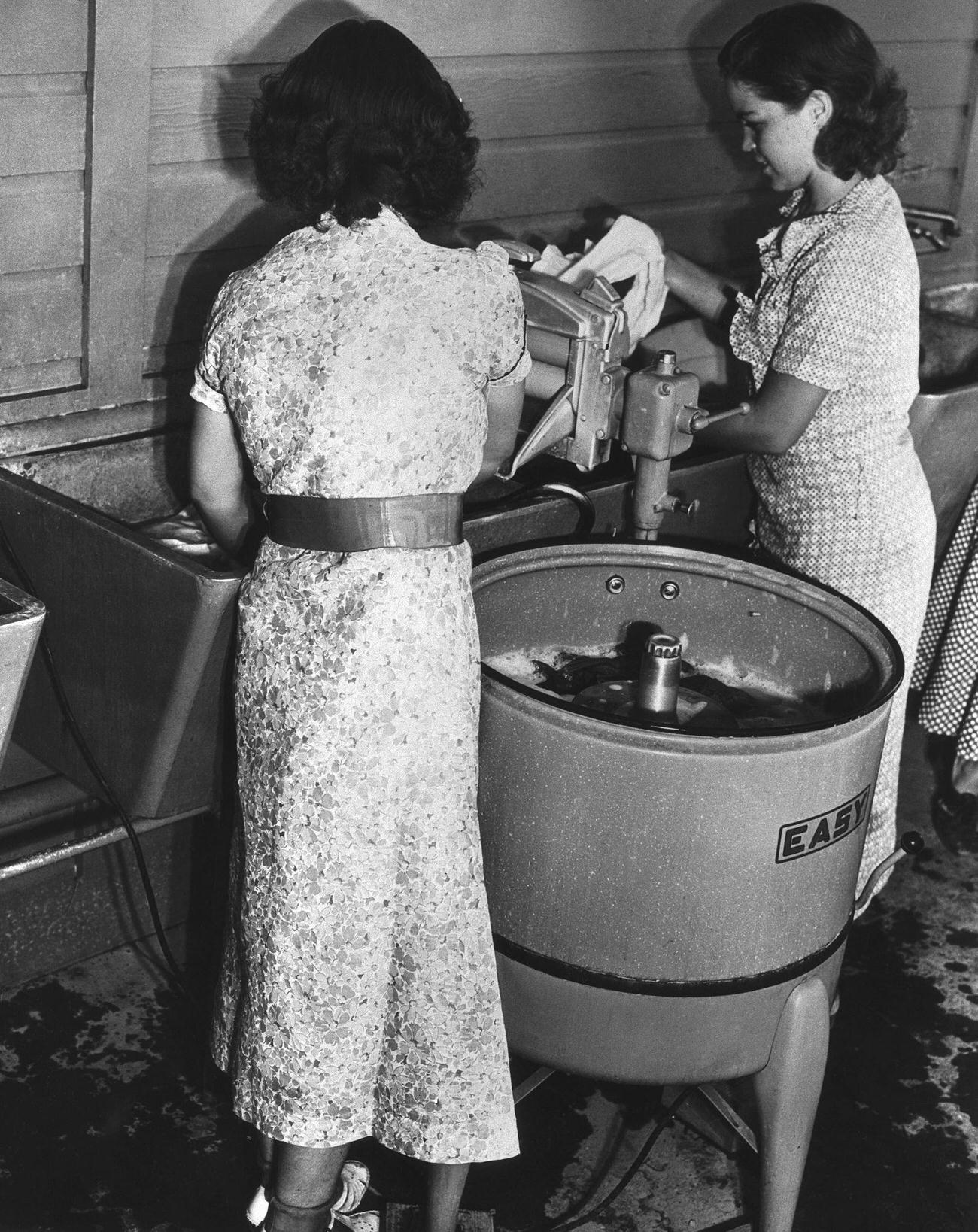
In a plain, workmanlike laundry room, two girls stand shoulder to shoulder at a washing machine fitted with a hand-fed wringer, their dresses practical and their attention fixed on the rollers. One guides a damp garment into the mechanism while the other steadies the load, a small choreography of teamwork that turns a heavy household chore into a shared routine. The scene is rich with period texture—wooden walls, deep tubs, and the bulky rounded body of the machine—hinting at a time when “doing the wash” was an event measured in hours, not minutes.
The wringer itself is the star of this moment in the history of inventions: a simple pair of pressure rollers that promised faster drying by squeezing water out of fabric before hanging or further rinsing. It represents that transitional era of domestic technology when electricity and machinery entered the home, yet many steps still depended on careful hands and constant vigilance. The device could be efficient, but it also demanded respect; feeding cloth evenly and keeping fingers clear was part of the everyday expertise learned at the wash.
Beyond the mechanics, the photograph speaks to how household labor was taught and passed along, often early, through observation and participation. These girls using a wringer at a washing machine offer a window into the rhythms of domestic life and the incremental innovations that reshaped it—one appliance, one attachment, one improved routine at a time. For anyone interested in vintage laundry equipment, early washing machines, or the social history of home technology, this image invites a closer look at the work behind clean clothes.