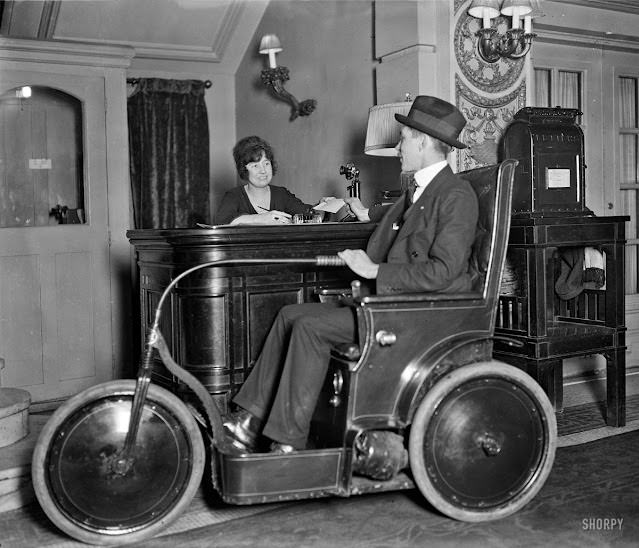
A man in a suit and brimmed hat pauses at an indoor counter while seated in the Custer Chair Car, an early mobility invention that looks like a cross between a wheelchair and a compact automobile. Its broad fenders, sturdy frame, and enclosed wheels hint at the decade’s fascination with streamlined engineering, even when the goal was simply to help someone move independently through everyday spaces. Behind the counter, a woman leans forward in conversation, turning what could be a clinical device into part of ordinary social life.
Details in the room—paneled woodwork, a curtained doorway, and wall sconces—place the scene in a public interior where the chair car’s practicality could be tested in real time. The machine’s hand controls and upright seating suggest it was meant to be driven with confidence, not pushed as an afterthought. In the Roaring ’20s, when invention culture promised modern solutions for nearly everything, assistive technology like this carried a quieter kind of optimism.
The Custer Chair Car endures in historical photos because it speaks to progress measured in dignity as much as speed. For readers interested in 1920s inventions, disability history, and the evolution of personal transportation, the image offers a rare glimpse at how mobility aids were marketed and experienced—visible, mechanical, and unapologetically modern. It’s a reminder that “hope” in the age of innovation often arrived on small wheels, one practical improvement at a time.