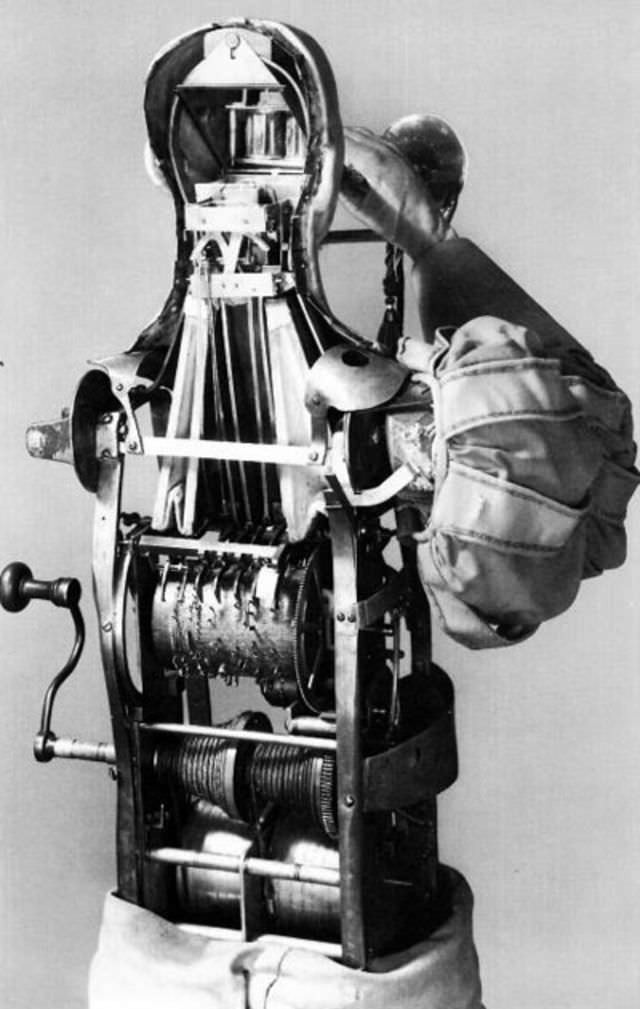
Seen from behind, the Automaton Trumpet Player becomes less a performer and more a compact cabinet of ingenuity. Metal ribs and braces outline a torso-like frame, while a cluster of levers, rods, and valves hints at the choreography required to imitate breath and fingerwork. Even without a face in view, the silhouette suggests a human figure, inviting the viewer to imagine the music that would emerge when the mechanism is set in motion.
At the center sits a pinned cylinder studded like a mechanical memory, the sort of programmable heart that powered many early inventions in automated entertainment. A hand crank on the side implies manual winding, and below it tightly coiled springs and stacked components speak to stored energy released in carefully timed pulses. The trumpet itself curves outward, and a padded, glove-like piece near the end reads as an attempt to soften or shape contact—an engineer’s practical answer to the delicate business of making a machine “play” rather than merely clatter.
For anyone interested in the history of inventions, this rear view is a rare reminder that wonder often depends on unseen labor. Automata were built to charm audiences, yet their artistry was equally in the hidden linkages that translated simple rotation into lifelike motion. The back view of the Automaton Trumpet Player rewards close looking, offering an SEO-worthy glimpse into early mechanical music, programmable motion, and the long lineage of robotics before electronics took the stage.