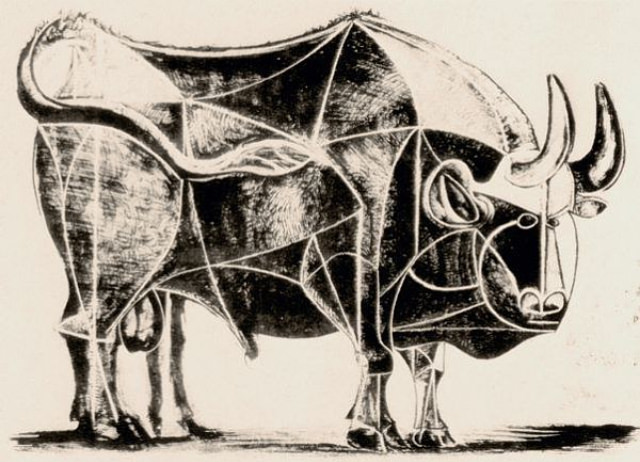
Plate 4 marks a decisive shift from observation to construction, where the bull’s powerful body is no longer modeled by soft transitions but by a scaffold of simplified forms. Bold outlines pin the figure to the page, and the animal’s mass is organized into clear planes that read almost like cut facets. The result feels both recognizable and newly engineered, as if anatomy has been translated into a language of angles and measured curves.
Across the torso, a network of guiding lines and geometric intersections maps the shoulder, ribcage, and hindquarters, turning muscle into structure. Dark, weighty shading concentrates in the core, while lighter passages along the back and belly help the silhouette breathe and stay legible. The head, horns, and eye are rendered with economical precision—enough detail to preserve character, yet restrained so the larger abstraction remains the focus.
Seen in the context suggested by the title, this artwork invites close looking at how an artist learns to reduce complexity without losing presence. It’s an instructive moment in the progression of a bull study: the animal becomes an arrangement of major anatomical planes, ready for further transformation in later plates. For readers interested in drawing, modernist process, or the history of abstraction, Plate 4 offers a compelling snapshot of analysis becoming style.