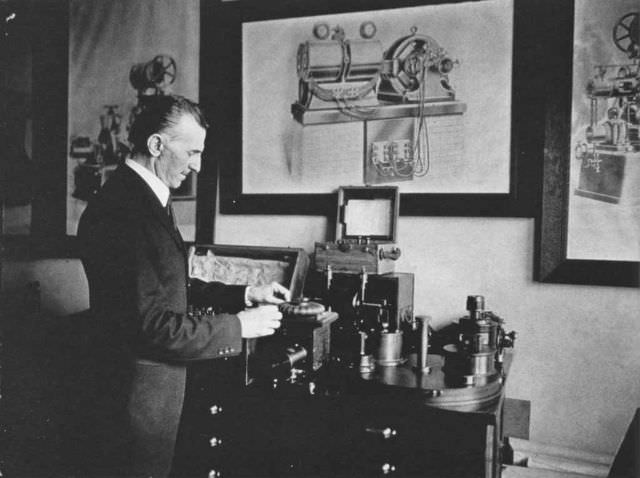
Nikola Tesla stands at a workbench in this 1916 photograph, absorbed in the careful handling of a compact machine that looks equal parts instrument and prototype. The scene feels like an engineer’s sanctuary: sturdy cabinetry, neatly arranged components, and the quiet seriousness of a laboratory where ideas are tested by hand as much as by theory. It’s a candid glimpse of Tesla not as a distant legend, but as a working inventor surrounded by the practical realities of hardware and experimentation.
Behind him, framed technical drawings hang on the wall, outlining mechanical forms that echo the apparatus on the table and hint at an organized pipeline from concept to construction. Cylindrical parts, gauges, and housings cluster around the central device, suggesting measurement, calibration, and iterative tinkering—hallmarks of early 20th-century innovation. The composition highlights the relationship between inventor and invention, emphasizing process rather than spectacle.
For readers interested in Nikola Tesla, inventions, and the history of technology, this image offers a textured look at the period when modern electrical and mechanical systems were still being refined in workshops like this one. The 1916 date places it in a mature phase of Tesla’s career, making the photograph especially valuable as documentation of his continued engagement with hands-on development. Whether you’re exploring vintage science photography or tracing the evolution of engineering practice, the details here reward a closer look.