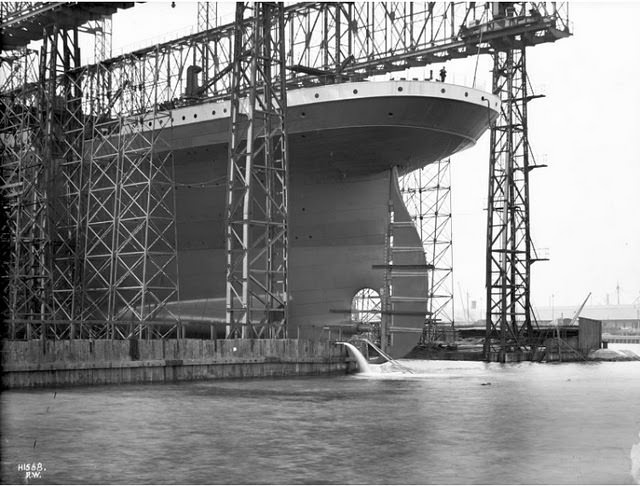
Steel fills the frame as an immense ocean liner’s bow rises above the waterline, still cradled by a dense forest of scaffolding and gantries. The hull’s curved plates, punctuated by rows of openings, hint at the careful choreography of riveting and fitting that turned raw metal into a ship meant to astonish the world. Even before paint and polish, the scale alone explains why the Titanic’s construction became a spectacle in its own right.
Along the slipway, the industrial architecture surrounding the vessel tells as much story as the ship itself: towering trusses, catwalks, and temporary frameworks built to tame a project of unprecedented size. This is the era when shipbuilding was a headline-making blend of brute force and precision, powered by cranes, teams of skilled laborers, and the latest thinking in maritime engineering. For readers searching Titanic construction photo history, the scene offers a grounded look at the practical work behind the myth.
Out of such yards grew the legend of an “unsinkable” marvel—less a single claim than a mood of confidence in modern design, compartmentalization, and ambitious new technologies marketed as progress. The image invites a closer look at how inventions and industrial methods shaped the Titanic’s rise to fame long before it ever carried passengers, and why the story of its building remains inseparable from the story that followed. Seen in mid-creation, the liner becomes not just a ship, but a symbol of an age that believed engineering could conquer the sea.