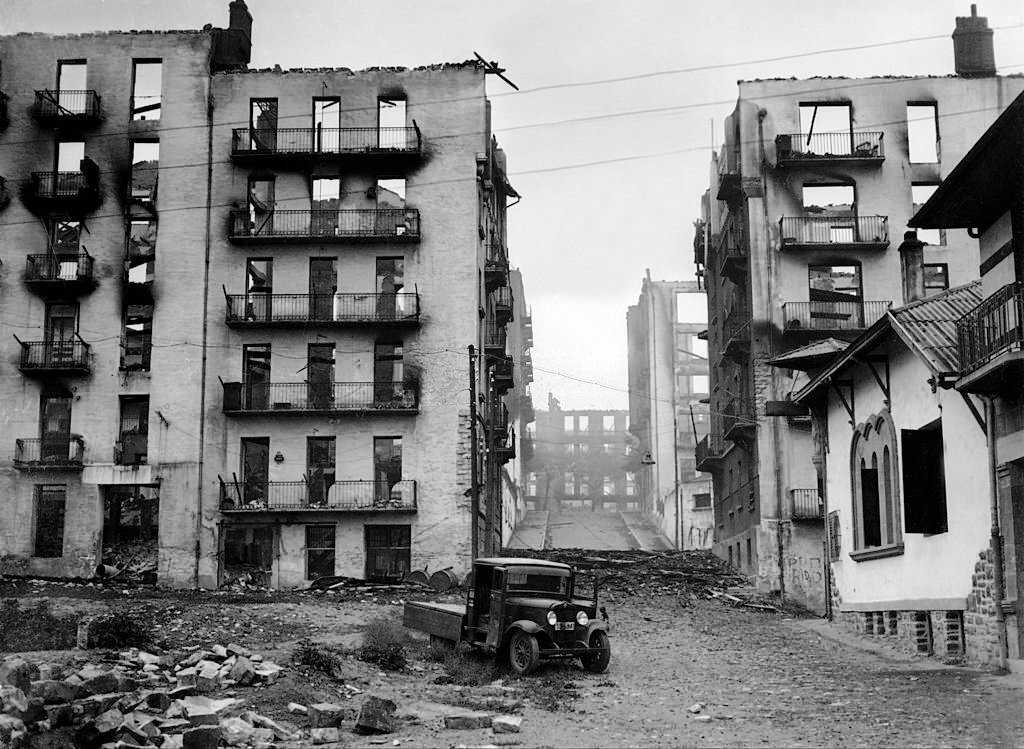
Charred facades and hollowed window frames dominate the street in Irun, turning ordinary apartment blocks into stark shells of their former lives. Balconies hang over emptiness, soot stains climb the walls, and piles of broken masonry spill into what would have been a busy urban corridor. A lone truck sits amid the debris, its presence underscoring how quickly daily routines can be interrupted when war reaches the doorstep.
In 1936, as the Spanish Civil War spread, bombing and urban fighting left many communities grappling with sudden devastation, and this scene speaks to that wider pattern without needing embellishment. The photograph’s long perspective draws the eye toward additional ruined structures in the distance, suggesting damage that extends beyond a single block. Even the intact building at the right edge feels precarious beside the gutted buildings, highlighting the uneven, chaotic footprint of violence.
For readers searching for Spanish Civil War history, Basque Country wartime photographs, or the story of Irun in 1936, this image offers a powerful visual record of destruction and survival. It invites attention not just to the physical wreckage—collapsed roofs, shattered interiors, streets turned to rubble—but also to the human aftermath implied by the absence of residents. As a historical photo, it anchors the abstract language of “civil wars” in a specific urban landscape where the cost of conflict is etched into stone and plaster.