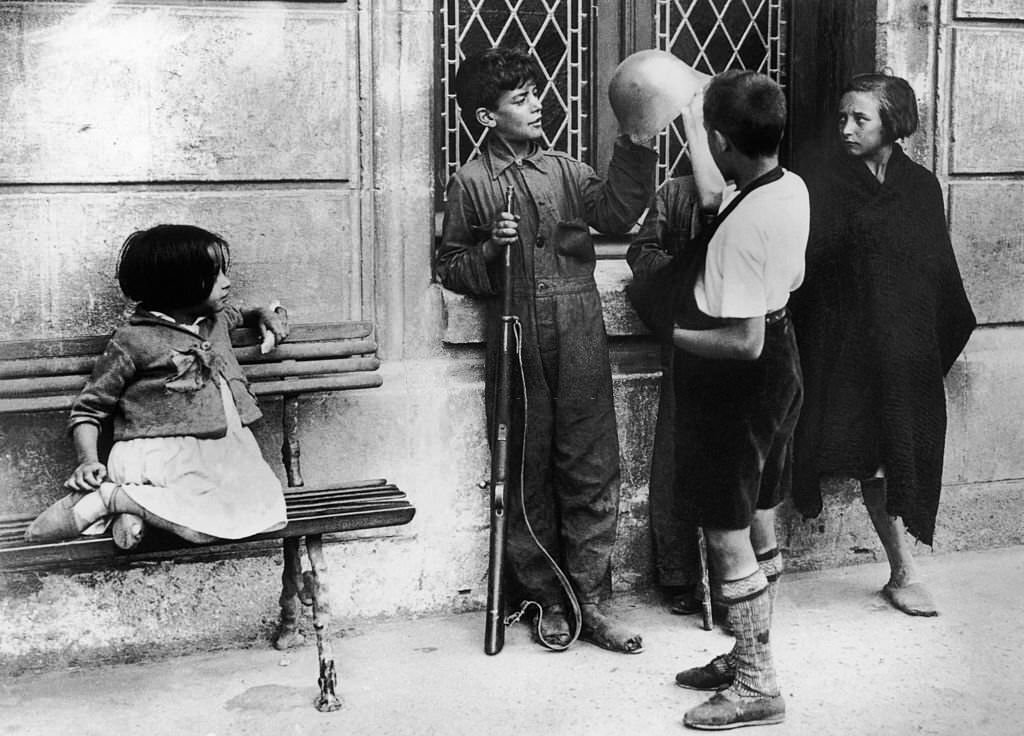
Outside a plain stone wall in Burgos, a small cluster of children gathers around objects that suddenly seem too heavy for their hands: a soldier’s helmet and a rifle. One boy holds the weapon upright with a practiced seriousness, while another leans in to look more closely, as if trying to understand what it means to carry such things. Off to the side, a girl perched on a bench watches, caught between curiosity and caution.
The title frames these items as belonging to an elder brother signed up in Franco’s troops, and that context sharpens the scene’s quiet tension. Wartime propaganda often celebrated enlistment and uniforms, yet the everyday street-level reality appears here in glances and posture rather than slogans. The helmet becomes more than equipment; it reads as a household relic of the Spanish Civil War, passed briefly into children’s play and wonder.
Details in the background—ironwork over the window, the worn bench, the bare feet and wrapped shoulders of one onlooker—anchor the photograph in ordinary life disrupted by civil conflict. No battlefield is visible, but the war is present in what the children touch and how the others look on. For readers searching Spanish Civil War history, Burgos wartime imagery, or the social impact of Franco’s forces, this photo offers an intimate, unsettling reminder of how quickly war enters the routines of the young.