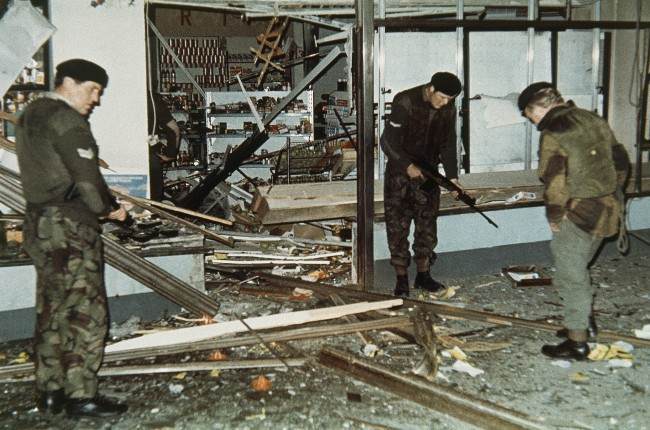
Jagged beams and shattered shop fittings spill across the floor where a supermarket once offered the routines of daily life, now reduced to a dangerous maze of splintered wood and broken glass. British troops move carefully through the wreckage, rifles in hand, their attention fixed on what might be hidden among the debris. The scene, tied by the title to Cavehill Road in Belfast in 1971, compresses the chaos of an explosion into a single, unnerving moment of inspection and uncertainty.
In the background, shelves and signage are left twisted and exposed, hinting at how quickly a commercial interior can become a disaster zone when violence intrudes. The soldiers’ stance suggests more than simple cleanup; they appear to be searching for clues, hazards, or further devices, treating ordinary retail space as contested ground. Even without visible crowds, the emptiness speaks loudly—an everyday public place abruptly emptied and made perilous.
Set within the wider conflict of Northern Ireland’s Troubles, the photograph underscores how attacks reached into neighborhoods and shopping streets, drawing security forces into the intimate spaces of civilian life. For readers exploring Belfast history, Cavehill Road, or British Army operations during 1971, the image offers a stark reference point: the aftermath rather than the blast itself. It also invites reflection on the civilians who would have shopped here, and on the long shadow such incidents cast over communities trying to live through upheaval.