Category: Colorization
See history come to life with colorized photographs of the past. From wars to daily life, these restored images bridge time with emotion and realism.
Each colorized photo revives forgotten stories and gives a fresh perspective on iconic historical moments.
-

#116 Paris, 1920s
Along a quiet Paris riverside promenade, spring-green trees cast soft shade over a stone embankment while two men pause near the wall, their dark coats and hats setting them apart from the bright walkway. The colorization brings out the gentle contrast between fresh foliage and pale masonry, turning what could feel distant into a scene…
-
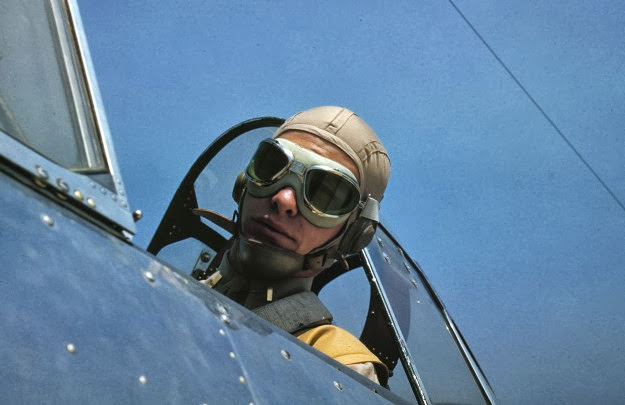
#11 A Marine lieutenant glider pilot in training at Page Field, Parris Island, South Carolina, 1942.
Leaning out of the cockpit with goggles pulled tight and a leather flying helmet snug under the chin, a U.S. Marine lieutenant glider pilot meets the camera with the calm focus of someone still learning a dangerous craft. The colorization brings out the hard gleam of the aircraft’s metal skin, dotted with rivets, and the…
-
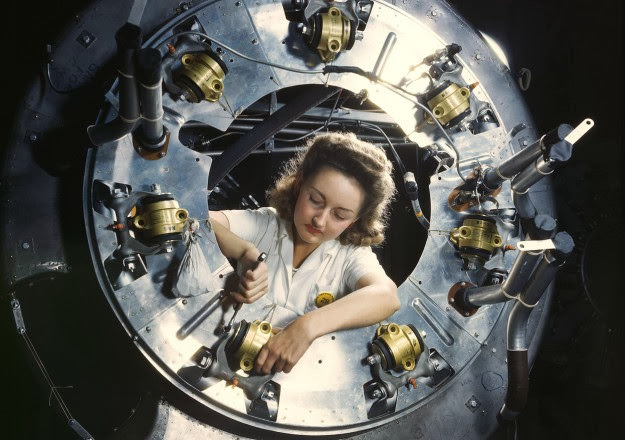
#27 Part of a cowling for a B-25 bomber motor is assembled at North American Aviation’s Inglewood, California, plant, 1942.
Framed by the bright ring of metal, a factory worker leans into the circular opening of a B-25 bomber engine cowling, hands busy with a tool as fittings and fasteners catch the light. The colorization emphasizes the polished surfaces and the dense, mechanical rhythm of the assembly—components repeating around the circumference like a clockwork halo.…
-
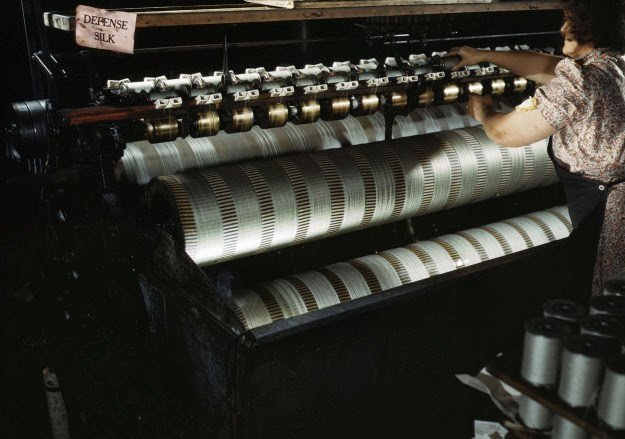
#43 A water stretching machine stretches parachute shroud lines in Manchester, Connecticut, 1942.
Industrial wartime production fills the frame in Manchester, Connecticut, where a water stretching machine is set up to pull parachute shroud lines to exacting standards. Ranks of taut, pale cords run across rollers and guides, turning a task that once depended on hand feel into a repeatable, calibrated process. A small sign reading “DEFENSE SILK”…
-
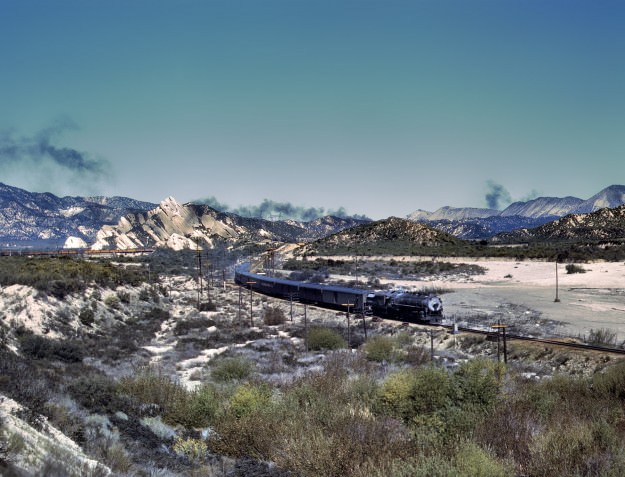
#14 March 1943. Santa Fe trip from Chicago to California. Trains on the Santa Fe tracks through Cajon Pass in the San Bernardino Mountains. 4×5 Kodachrome transparency by Jack Delano for the Office of War Information.
March 1943 on the Santa Fe line: a long passenger train rounds a broad curve through Cajon Pass, its dark locomotive pulling a string of streamlined cars beneath a wide desert sky. Smoke drifts low across the valley floor, tracing the engine’s effort as it climbs through the San Bernardino Mountains, while telegraph poles and…
-
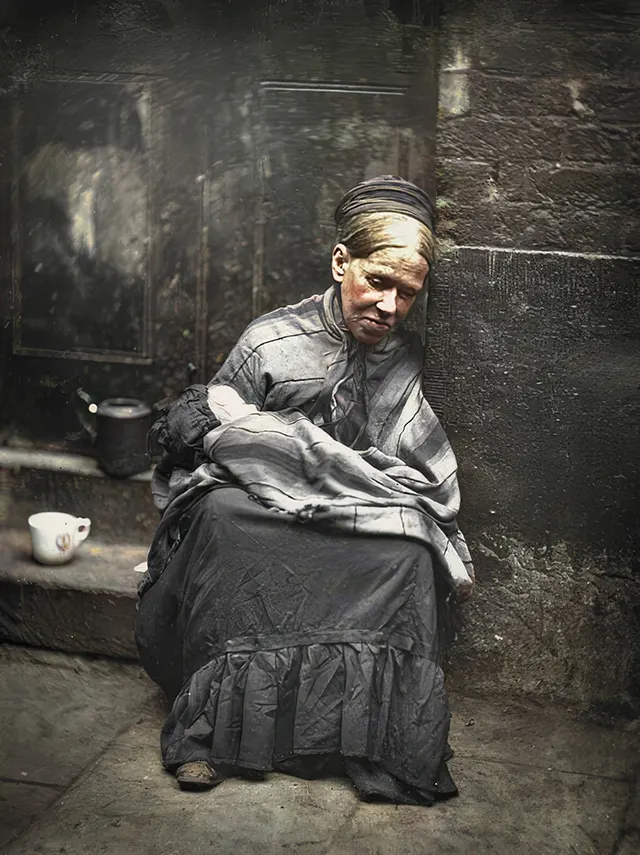
#7 A homeless woman and her young son, 1890s.
Leaning into a rough stone corner, a weary mother gathers her clothing tightly around her as if to make a shelter out of fabric alone. The colorization brings out the muted grays of her shawl and skirt, the grime and wear in each fold, and the bruised tones of a face that has seen too…
-
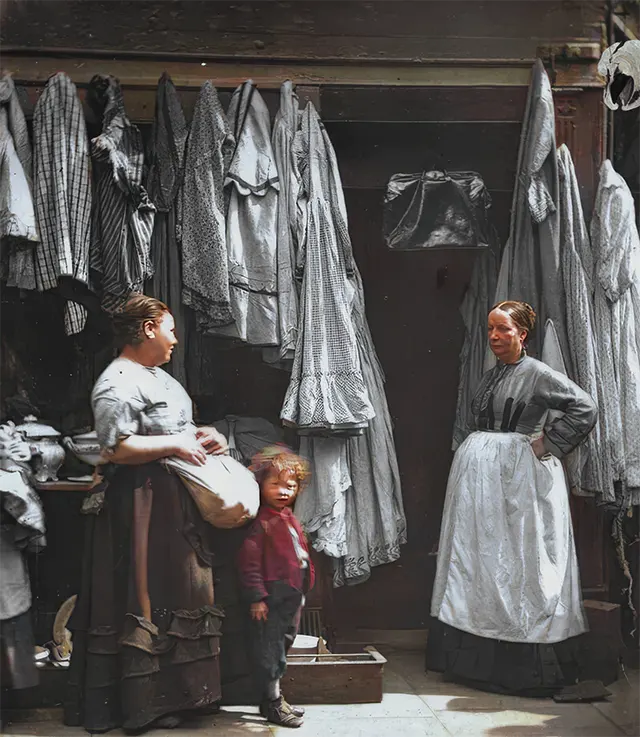
#23 Two women and a child at a secondhand clothing shop in St. Giles, 1890s.
A narrow secondhand clothing shop in St. Giles becomes a stage for everyday survival in the 1890s, with garments crowding the walls like a fabric archive. Dresses, aprons, and shirts hang in dense rows, their folds and patterns made newly legible through colorization. The cramped interior hints at a brisk trade where space is precious…
-
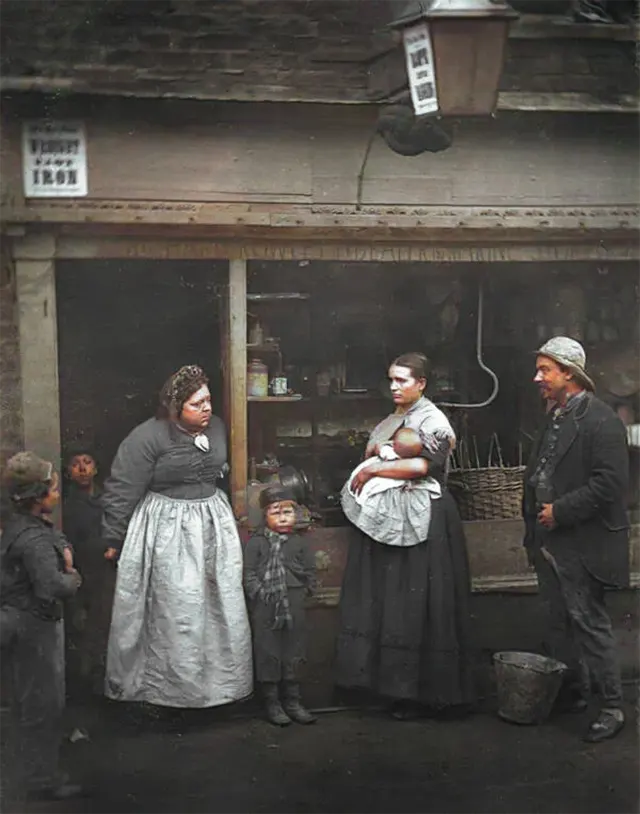
#39 People gather outside of a rag shop in Lambeth, 1890s.
In Lambeth in the 1890s, a small rag shop could be as essential as any grocer, and the gathering at its doorway hints at the everyday economy of making do. The colorization draws the eye to worn aprons, dark skirts, and work-stained clothing—practical layers suited to long days and tight budgets. A hanging street lamp…
-

#14 The dead body of Al Capone associate Charles “Cherry Nose” Gioe, who was shot through the head by mafia hitmen hired by a Chicago mob boss whose plans Gioe had unknowingly interfered with, 1954.
Slumped across the front seat of a beige car interior, Charles “Cherry Nose” Gioe lies motionless with his face turned toward the upholstery, a dark pool spreading beneath his head. The driver’s door hangs open, exposing the steering wheel, dash, and pedals in stark, almost clinical detail—everyday mechanics framing a moment of sudden violence. The…
-

#30 Murdered gangster David Beadle, also known as “David the Beetle,” in front of The Spot Bar and Grill in Manhattan, 1939.
Under the glowing sign of The Spot Bar-Grill, the sidewalk becomes a crime scene in 1939 Manhattan, rendered all the more immediate through modern colorization. A body lies at the curb with a hat knocked free, a dark pool spreading across the pavement, while the restaurant’s broad windows and hanging lights suggest a normal night…