Category: Colorization
See history come to life with colorized photographs of the past. From wars to daily life, these restored images bridge time with emotion and realism.
Each colorized photo revives forgotten stories and gives a fresh perspective on iconic historical moments.
-
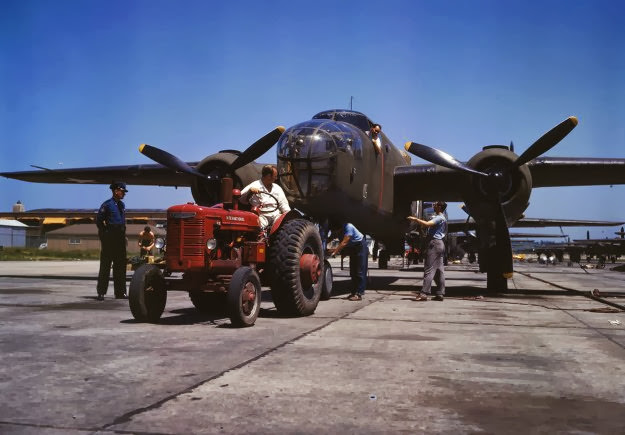
#32 B-25 bombers at North American Aviation, Inc., are hauled along an outdoor assembly line in Kansas City, Kansas, 1942.
Under a wide Midwestern sky, a B-25 bomber inches forward on the outdoor assembly line at North American Aviation, Inc., hauled by a sturdy red tractor across sunlit concrete. The colorization brings a striking immediacy to the scene: dark twin engines and broad wings dominate the frame while the greenhouse nose canopy gleams, hinting at…
-
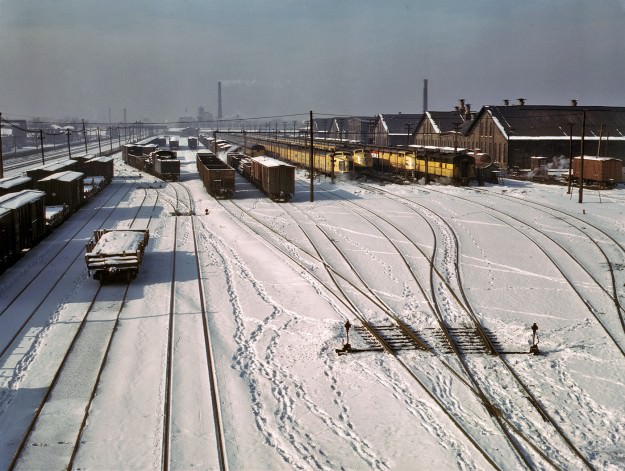
#3 December 1942. Three West Coast streamliners in the Chicago & North Western yards at Chicago. 4×5 Kodachrome transparency by Jack Delano.
Snow lies thick across the Chicago & North Western yards in December 1942, softening the hard geometry of rails that braid and diverge into the distance. From an elevated vantage, the scene reads like a working map: freight cars parked on sidings, switch stands poking through drifts, and footprints cutting an improvised path where the…
-
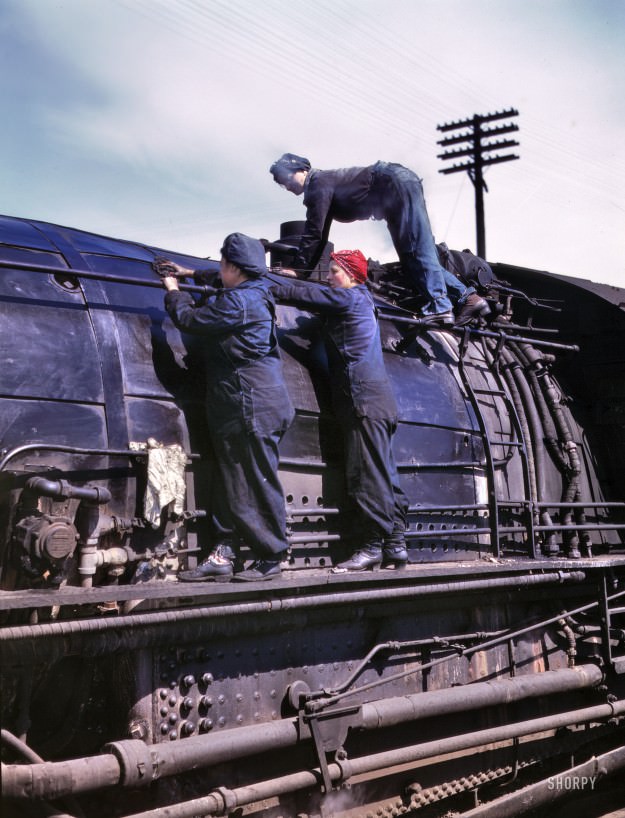
#19 Clinton, Iowa. April 1943. “Chicago & North Western Railroad. Women wipers at the roundhouse cleaning one of the giant H-class locomotives.” In the red bandanna: Marcella Hart, seen here in a few other posts. 4×5 Kodachrome transparency by Jack Delano for the Office of War Information.
Set against the working curves of a Chicago & North Western H-class steam locomotive, three women in coveralls lean into the unglamorous but essential job of wiping down metal skin and fittings at the Clinton, Iowa roundhouse. One steadies herself on the running board, another reaches forward with a rag, and a third crouches along…
-

#12 Ginger beer makers and “mush fakers” on Clapham Common, 1890s.
Under the trees on Clapham Common, a small handcart becomes a marketplace in miniature, piled high with bottles and wrapped parcels while passers-by pause to look on. The colorization brings out the everyday textures—workworn clothing, a dark coat and hat, the sunlit grass, and the pale neckerchiefs that read as instantly practical rather than posed.…
-
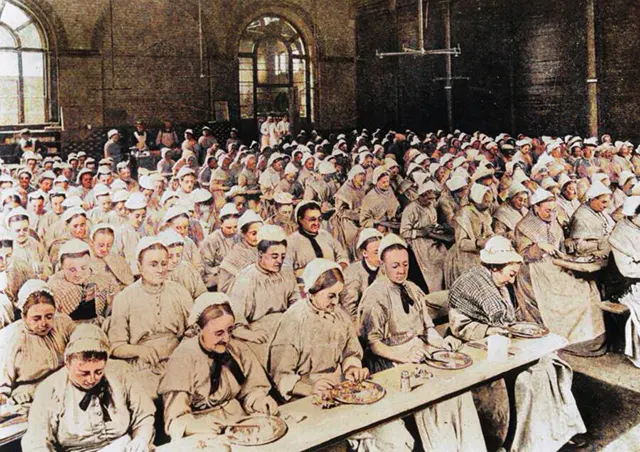
#28 Women eating dinner at a workhouse in St. Pancras, 1900.
Rows of women sit shoulder to shoulder at long wooden tables, their pale uniforms and white caps creating a striking rhythm across the dining hall at the St. Pancras workhouse. Tin or enamel plates, mugs, and cutlery line the benches with an almost institutional neatness, while a few faces glance toward the camera amid the…
-

#3 The body of mobster Benjamin “Bugsy” Siegel, who was killed by an unknown assailant who shot him through a window with an M1 Carbine while he was staying at an associate’s house in Beverly Hills, 1947.
A brutal stillness hangs over the scene: Benjamin “Bugsy” Siegel lies slumped on a sofa, his face and clothing stained with blood, the domestic calm of cushions and curtains shattered in an instant. In the foreground, a small bronze nude figurine—arms raised in a frozen gesture—creates a jarring contrast with the violence behind it. The…
-

#19 A New York police officer takes a peek at a dead body covered with newspapers, 1943.
Under the harsh glare of street-side lighting, a New York police officer bends at the waist and lifts a corner of newspaper, his posture caught between routine duty and reluctant curiosity. The scene is rendered in colorization, making the dark blue uniform and brass buttons feel immediate, while the pavement reads as cold, damp, and…
-
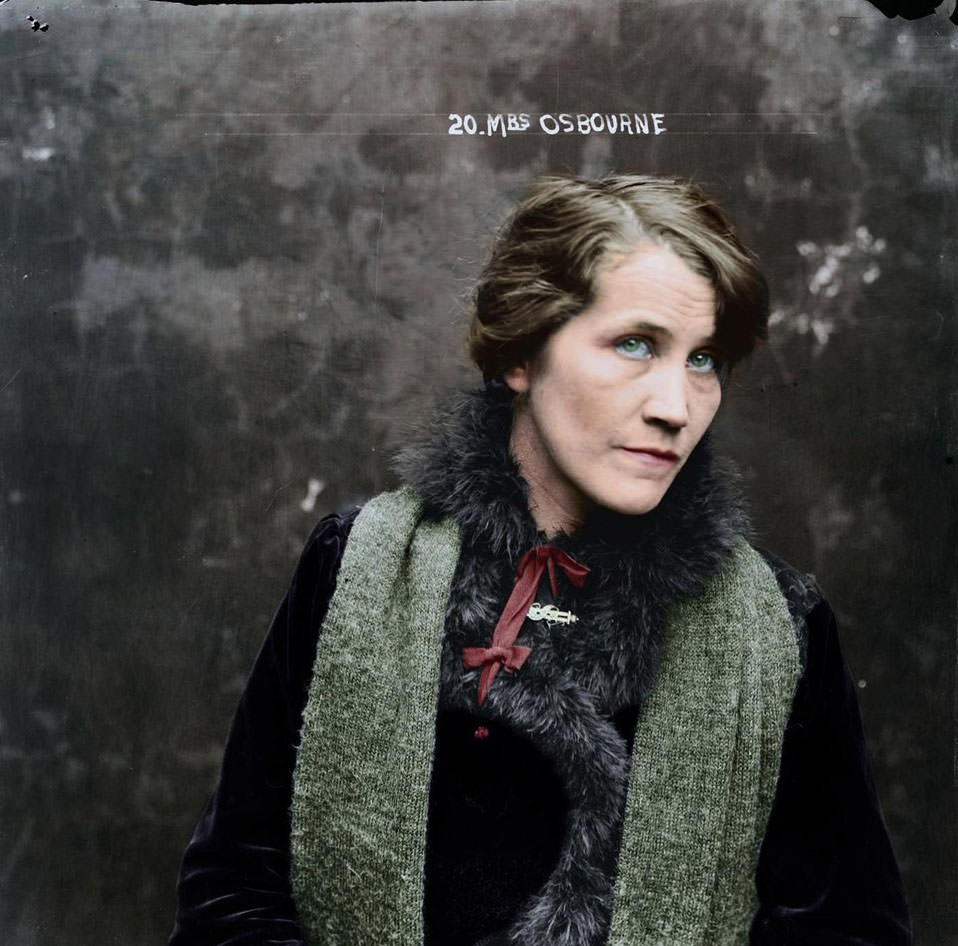
#4 Mrs Osbourne, location and details unknown, around 1919.
Mrs Osbourne meets the camera with a steady, unsmiling gaze, her face turned slightly aside as if interrupted mid-thought. The colorization brings forward striking details—cool-toned eyes, the soft sheen of neatly arranged hair, and the contrast between dark clothing and a textured outer layer that reads like a heavy wrap or vest. Behind her, a…
-
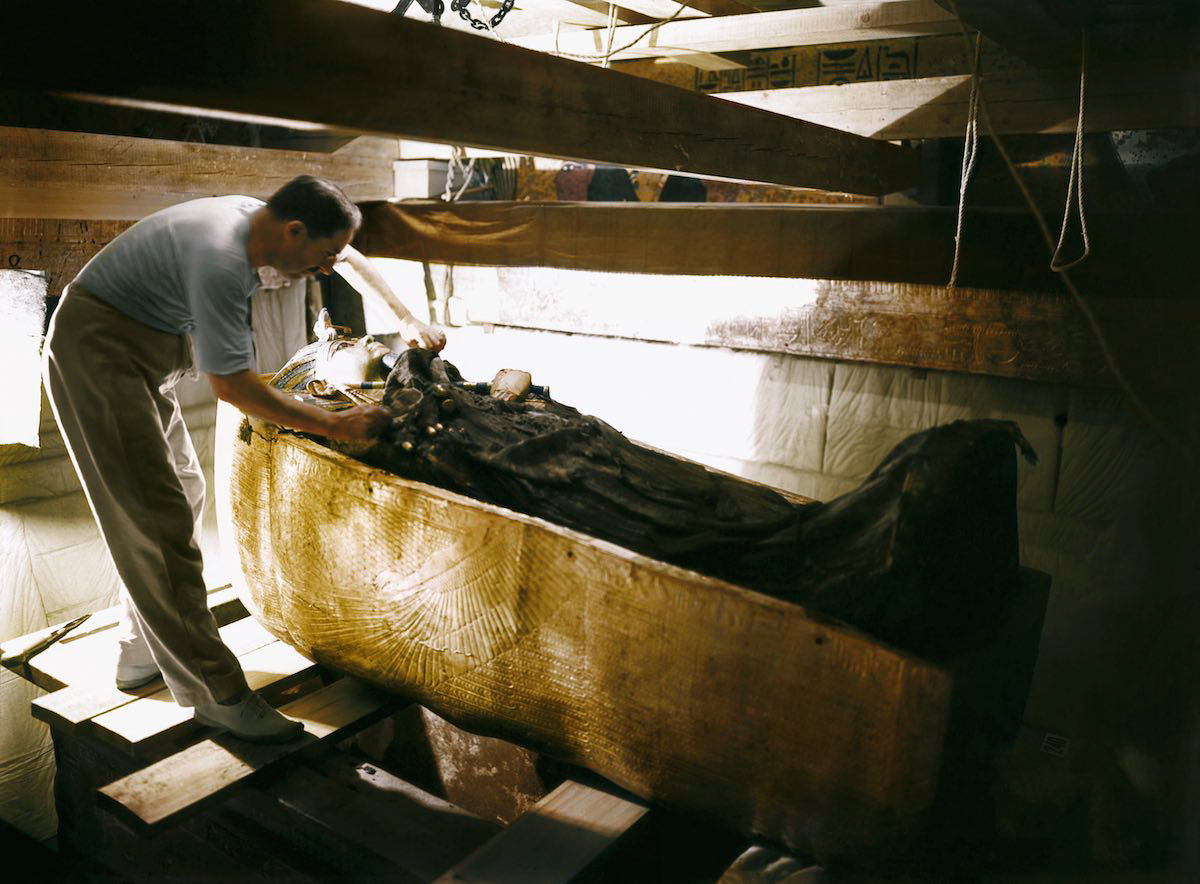
#10 Howard Carter working on the lid of the second (middle) coffin, still nestled within the case of the first (outermost) coffin in the Burial Chamber. Tutankhamun’s Tomb, October 1925
Leaning over the gilded contours of a nested coffin, Howard Carter appears absorbed in the careful, physical work of discovery—hands close to the lid, posture tense with concentration. The colorization brings out the warm sheen of gold against the dim, workshop-like atmosphere of the Burial Chamber, where heavy beams and rigging hover overhead. Light pools…
-
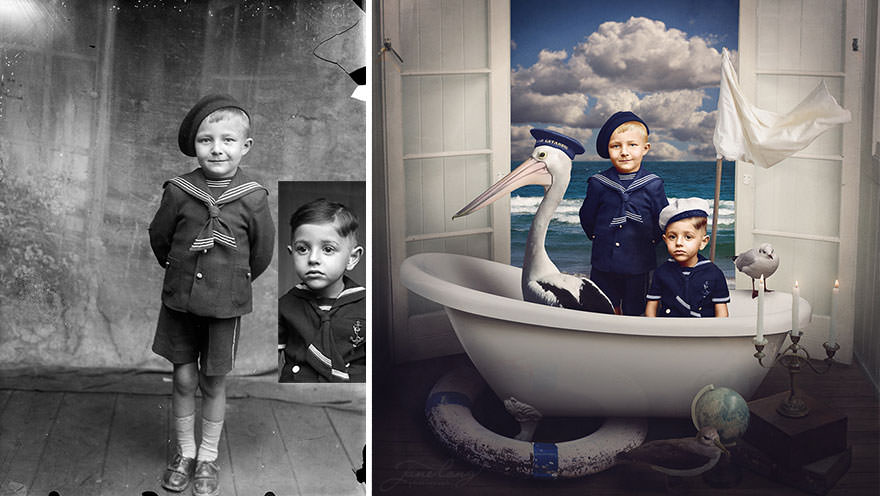
#5 Photographer Recolor Historic Glass-Plate Photos With His Conceptual And Artistic Imagination #5 Colori
Between the cracks and stains of an old glass-plate portrait, two children in sailor-style outfits hold their poses with the practiced stillness of early studio photography. On the left, the original monochrome print keeps the setting spare: a worn backdrop, bare floorboards, and the slightly stiff formality that came with long exposures and careful staging.…