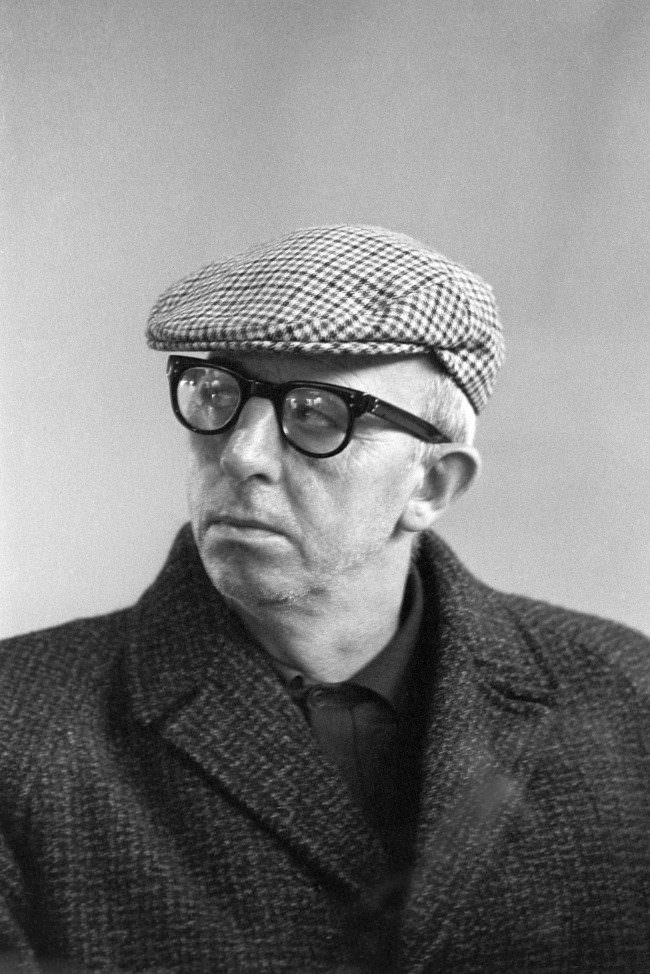
A hard, watchful profile fills the frame: Joe Cahill in thick overcoat and patterned cap, his dark-rimmed glasses catching a pale wash of light. The tight composition strips away distractions and leaves only expression and posture—guarded, deliberate, and unmistakably public. Even without the wider room in view, the portrait reads like a moment taken in the midst of argument, when every word might be weighed and repeated.
Set against the title’s setting—a press conference in a school gymnasium in Belfast’s Ballymurphy district—the photograph evokes the improvisation of conflict-era politics, where ordinary community spaces became stages for extraordinary statements. Leading figures of the Republican movement gathered to hear an anonymous IRA spokesman rebut the Army’s claim of “virtual victory,” turning the event into a contest not only of force but of narrative. The image’s spare background underscores that tension: a man presented to the press, yet insulated by the controlled neutrality of a plain wall.
For readers exploring the Troubles, Belfast history, and the media battleground of civil conflict, this photo offers a concentrated study in how leadership was performed and perceived. It invites attention to the visual language of authority—workmanlike clothing, steady gaze, minimal setting—used to project resolve amid uncertainty. As a historical snapshot tied to the Ballymurphy press conference, it also serves as a reminder that public memory often begins with a single face framed at the right instant.