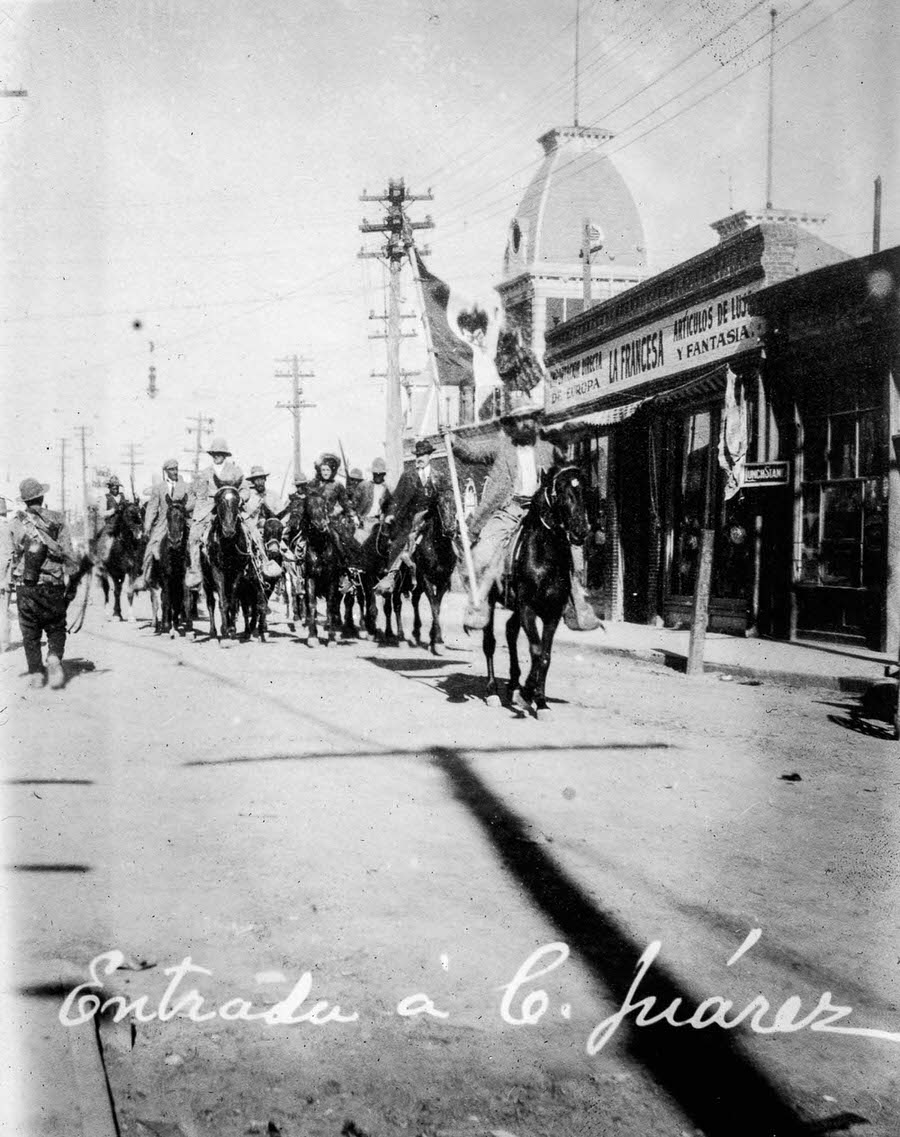
Dust hangs over a broad street in Ciudad Juarez as mounted revolutionary fighters ride forward in a loose column, their hats and bandoliers catching the hard daylight. One rider lifts a large flag high above the procession, turning the march into a public announcement of victory after the surrender of federal forces. Telegraph poles and overhead wires stretch into the distance, while a domed building anchors the scene and hints at the city’s civic center.
Along the right-hand side, storefronts line the route with bold Spanish signage painted across the façades, including a “Farmacia” and other commercial lettering that places the moment firmly in everyday urban life. The shutters and awnings appear drawn back as if the street has been cleared for the entry, and the quiet architecture contrasts with the restless movement of horses and men. Even without hearing it, the photograph suggests the clatter of hooves, murmured spectators, and the tense calm that follows a decisive change of power.
As a piece of Mexican Revolution history, the image carries the visual language of civil wars: improvised uniforms, civilian spaces turned into stages, and symbols elevated above the crowd to signal legitimacy. For readers searching for Revolutionary forces in Ciudad Juarez, surrender of federal troops, or early twentieth-century border-city street scenes, this photograph offers a vivid, ground-level view of transition. It preserves a fleeting instant when the outcome of a battle became a march, and a march became a message to the city.