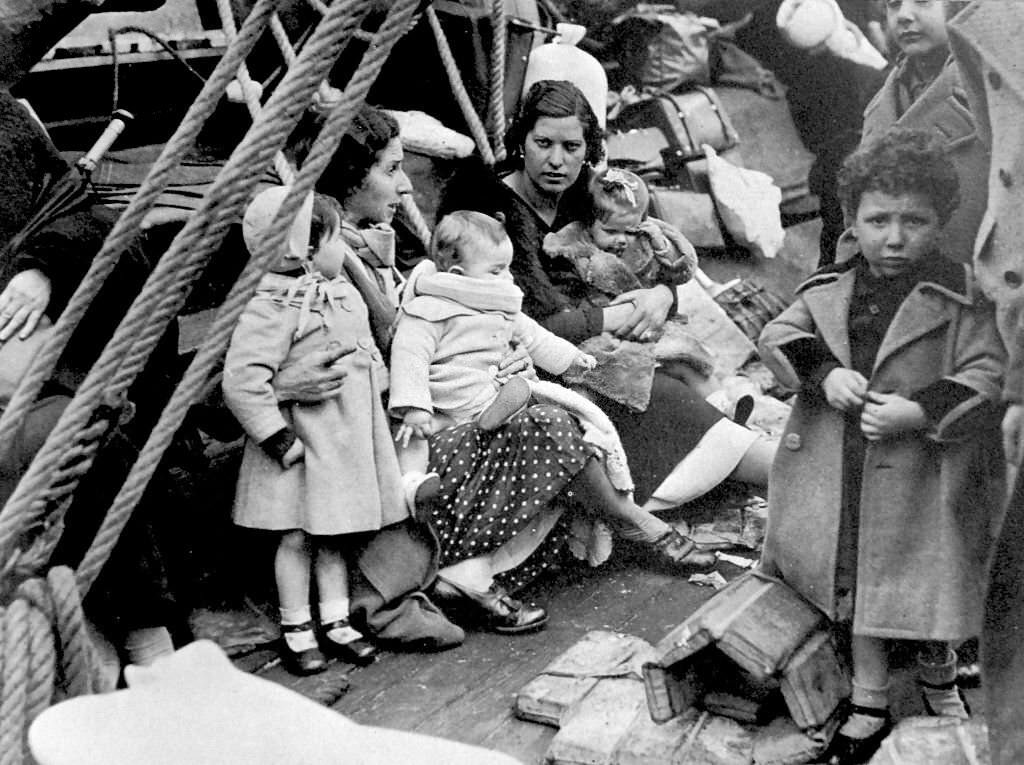
Ropes, bags, and bundled coats crowd the frame as women gather close with small children in their arms, the deck beneath them littered with the hurried traces of travel. An infant in a light outfit sits heavy in a lap, while another child clutches a toy or blanket, faces turned in different directions as if listening for instructions. The setting reads unmistakably as a moment in transit—families pressed together, possessions minimized, time running short.
Santander in 1937 stands as one of the Spanish Civil War’s most painful chapters, when civilians—especially the very young—were pushed onto evacuation routes in the hope of safety. Rather than battlefield drama, the photograph emphasizes the quieter violence of displacement: the careful grip of a mother’s hands, the wary stare of a child, and the unspoken calculation of what can be carried and what must be left behind. The sea voyage implied here becomes both refuge and uncertainty, a crossing that separated children from familiar streets, language, and often family itself.
For readers searching the history of Spain’s wartime evacuations, this image offers a stark, human-scale view of refugee life during the conflict. Clothing and expressions do much of the storytelling, showing how ordinary people endured extraordinary pressure with infants on their knees and luggage at their feet. It is a reminder that the Spanish Civil War was fought not only in headlines and front lines, but also in crowded departures where childhood was forced to grow up overnight.