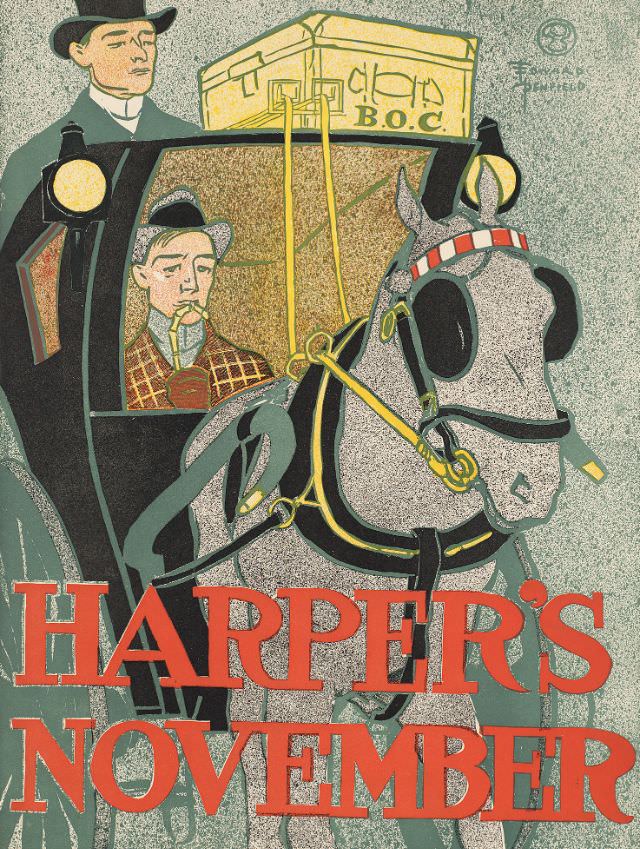
Bold lettering for “HARPER’S NOVEMBER” anchors this illustrated cover, while a horse-drawn coach rolls forward in crisp, stylized lines. A driver sits high on the box seat, composed and upright, as a passenger rides within the enclosed cab below. The harness and headgear of the horse, picked out with bright accents against a muted ground, give the scene both motion and ceremony—an everyday conveyance rendered as graphic design.
What stands out is the contrast between roles and vantage points: authority above, contemplation within, and steady labor in the animal’s stride. The passenger’s face, framed by the coach window, feels private and interior, while the driver’s position suggests visibility and control of the street ahead. Even without a specific setting named, the image evokes the late-19th-century urban rhythm when horses and carriages still set the pace of travel and public life.
As a piece tied to Harper’s in November 1896, the artwork works simultaneously as period illustration and cultural snapshot, reflecting the magazine’s knack for turning modern scenes into emblematic cover art. The simplified forms, limited palette, and confident outlines point to the era’s evolving print aesthetics, when mass publications competed for attention on crowded newsstands. For readers interested in transportation history, magazine illustration, or Gilded Age visual culture, this cover offers a vivid doorway into the texture of everyday movement at the end of the century.