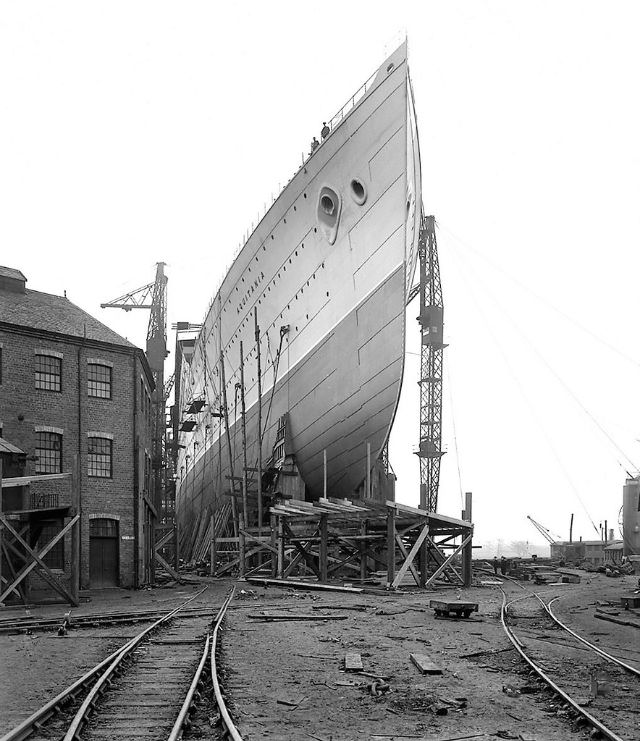
Rising like a sheer wall of steel, Aquitania looms over the Clydebank yard at John Brown, her bow towering above the cluttered ground works. The camera angle emphasizes scale: rails curve toward the slipway, timber staging braces the hull, and tall yard cranes stand ready beside the ship’s smooth plating. Even without a bustling crowd in view, the scene feels noisy with industry—an ocean liner taking shape in a landscape built for heavy engineering.
Along the hull, rows of portholes and neatly laid strakes hint at the careful planning behind every rivet line, while the temporary supports and scaffolding reveal the in-between moment of construction. The brick yard building to the left anchors the photo in the working world of the Clyde, where shipbuilding was both a craft and a vast industrial system. Details like the tracks, scattered materials, and open yard space speak to the logistics of moving parts, tools, and men around a project on this scale.
For readers searching naval history or the story of great Cunard liners, this image is a vivid reminder that glamour began long before the first passengers ever stepped aboard. Aquitania at the Clydebank yards represents the inventive problem-solving of early twentieth-century shipbuilding—how to assemble a floating city using cranes, rail lines, timberwork, and disciplined labor. It’s a portrait of ambition in steel, and of John Brown’s yards as a place where the modern age of ocean travel was physically forged.