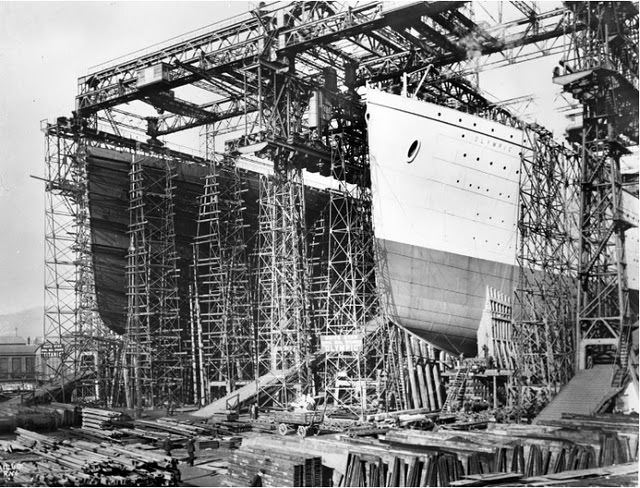
Steel scaffolding rises like a forest around an immense hull as the ship takes shape in the shipyard, its bow already asserting the scale that would soon astonish newspaper readers and passengers alike. Rivet lines stipple the plated surface, while gantries and cranes loom overhead, turning raw materials into a floating monument of industrial confidence. The scene is crowded with timber, beams, and work platforms, a reminder that “unsinkable” began as a promise made in workshops, drafting rooms, and noisy yards long before it became a headline.
Construction of the Titanic was as much a story of methods and inventions as it was of luxury: mass riveting, precision steel fabrication, and the logistics of coordinating thousands of parts into a single, coherent vessel. The photo invites a closer look at the practical ingenuity behind the romance—how workers and engineers relied on modular assembly, heavy lifting gear, and carefully staged scaffolds to build faster, bigger, and with tighter tolerances than earlier generations could manage. Even without named faces, the industry is present in every riveted seam and temporary support, suggesting the human effort hidden inside grand engineering claims.
Public fascination followed the ship’s rise from frame to fully fitted liner, and images like this helped transform a construction site into a symbol of modernity. For readers searching the history of the Titanic’s construction, shipbuilding technology, and early 20th-century engineering, this moment crystallizes the transition from blueprint ambition to physical reality. It’s a snapshot of an age when innovation was measured in tonnage and height—when the world watched a new marvel take form and believed progress could be made permanent in steel.