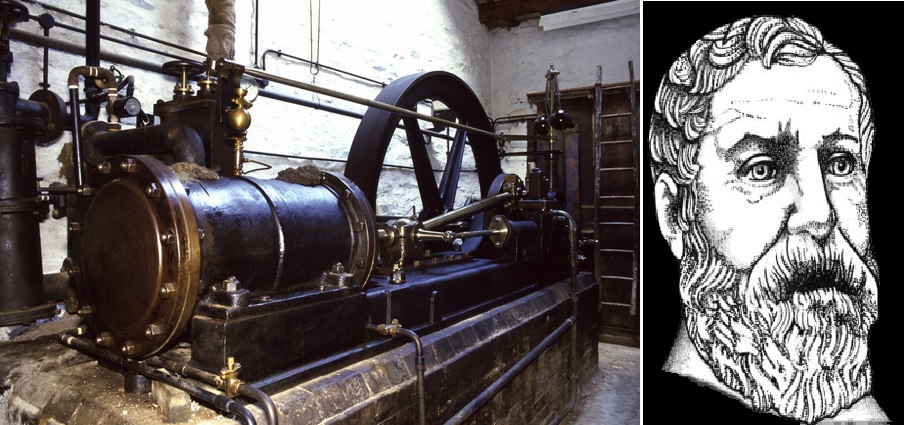
Iron and brass dominate the frame: a hefty cylinder, a web of pipes and valves, and a wide flywheel built for steady, relentless motion. Set against a rough, whitewashed interior wall, the machine’s polished fittings catch the light in a way that makes the engineering feel both practical and almost ceremonial. On the right, an engraved portrait of a bearded classical figure anchors the post’s theme in the long arc of ancient invention.
The title, “Steam Engine (1712) by Hero of Alexandria,” invites a conversation about origins and attributions, especially for readers tracing the history of steam power and early engines. Hero is remembered for ingenious devices that explored how heated air and steam could produce movement, even if the industrial steam engine as we recognize it belongs to a much later world of mines, mills, and manufacturing. Pairing the portrait with heavy machinery creates a visual bridge between theoretical curiosity and the era when steam finally became a dependable workhorse.
For a WordPress post tagged around inventions, this image works as a vivid gateway into topics like early mechanical engineering, the evolution of power systems, and the cultural afterlife of ancient science. The close-up details—bolts, joints, and carefully routed lines—also make it ideal for SEO searches related to steam engine history, Hero of Alexandria, and the development of industrial technology. Taken together, the elements suggest how ideas travel: from experiment and diagram to metal, motion, and the machines that reshaped everyday life.