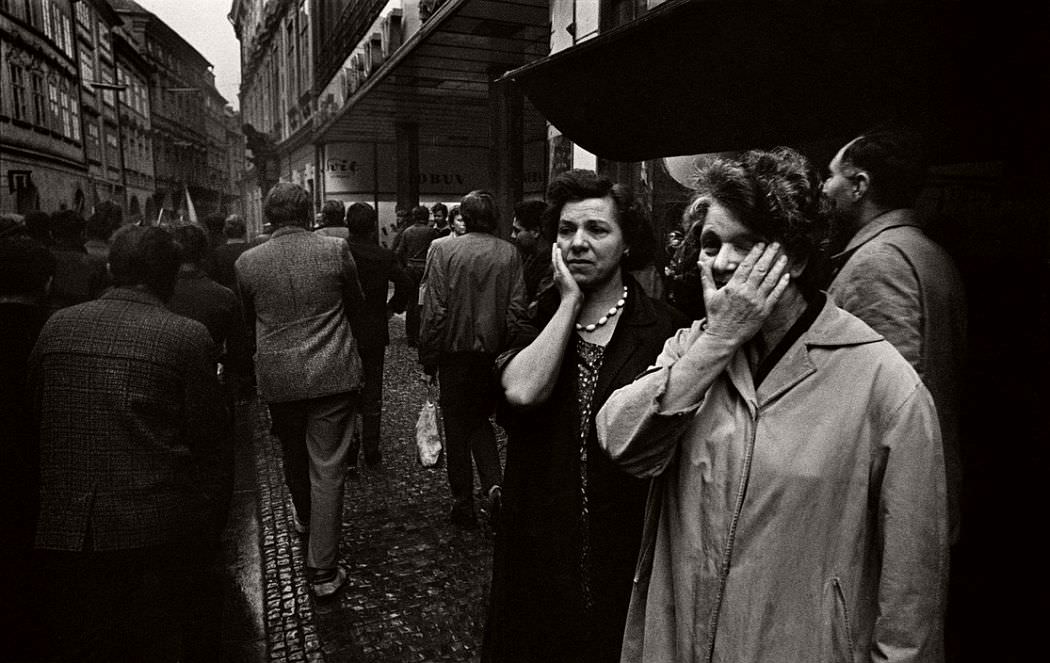
Under the heavy awning of a city street, two women stand apart from the flow of pedestrians, their hands pressed to their faces as if trying to steady themselves against what they are witnessing. Around them the crowd moves in tight clusters along cobblestones and older façades, the everyday architecture suddenly turned into a stage for extraordinary events. The grainy, high-contrast look of the photograph heightens the tension, drawing attention to small human gestures that speak louder than slogans.
The title points to the Soviet invasion of Czechoslovakia in 1968, when the Prague Spring reform movement was forcibly halted and the promise of change collided with the reality of power. Rather than tanks and banners, the frame concentrates on civilian reaction—shock, worry, and the uncertain pause that comes when history arrives in the middle of an ordinary day. It’s a reminder that political crackdowns are not only measured in decisions and decrees, but in the faces of people who must absorb the consequences in real time.
For readers searching for images of the 1968 Prague Spring, Warsaw Pact intervention, and Cold War unrest, this scene offers a grounded entry point into the lived experience of occupation. The crowd’s attention is pulled toward something outside the camera’s view, inviting questions about what happened just beyond the edge of the street and how quickly public space can transform under military pressure. In that sense, the photo becomes both documentation and memory—an intimate fragment of a wider crisis that reshaped Czechoslovak society.