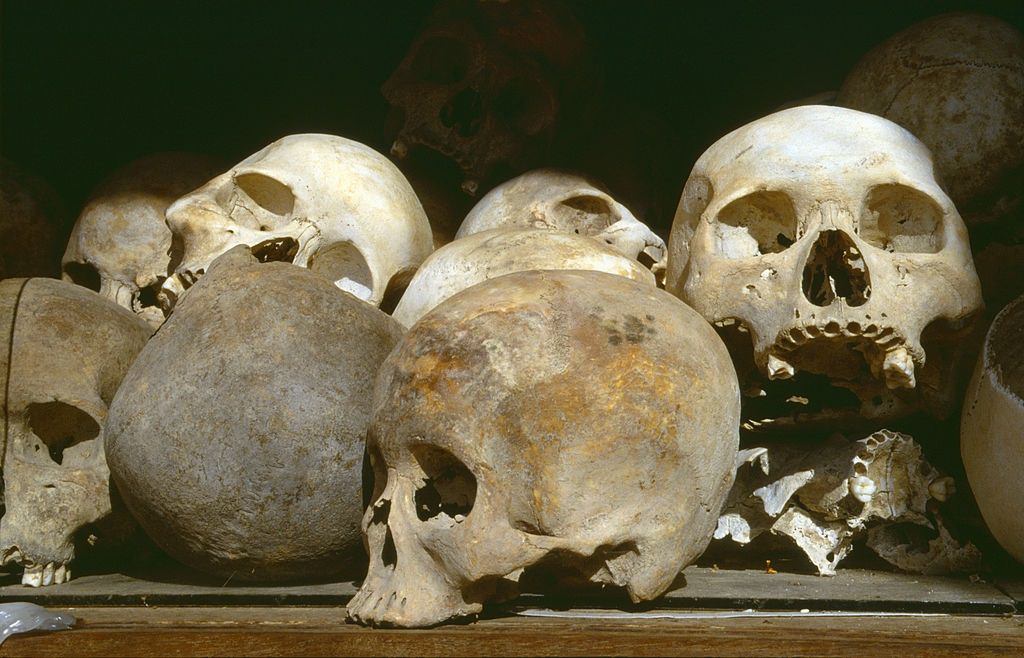
At Choeung Ek, the so-called Killing Fields, a dense row of human skulls rests in close quarters, their worn surfaces catching the light while the shadows behind them deepen the sense of silence. The arrangement is stark and deliberate, turning bone into testimony—empty eye sockets and broken teeth reading like an archive of violence. Even without faces or words, the remains communicate the scale of loss in a way documents rarely can.
Civil wars and state terror leave traces that outlast slogans, and the Choeung Ek memorial landscape is one of the most haunting in modern Southeast Asian history. The photo’s tight framing emphasizes accumulation rather than individuality, forcing the viewer to confront how quickly human lives can be reduced to evidence. It is a difficult image, but it is also an essential one for anyone trying to understand the Khmer Rouge era and its enduring aftermath.
For readers seeking historical context, this post reflects on remembrance, documentation, and the ethics of viewing atrocity through photographs. The skulls at Choeung Ek are not symbols in the abstract; they are the physical remnants of people whose stories were cut short, now preserved to warn against repetition. In that sense, the Killing Fields stand as both a site of mourning and a record of genocide that continues to shape Cambodia’s collective memory.