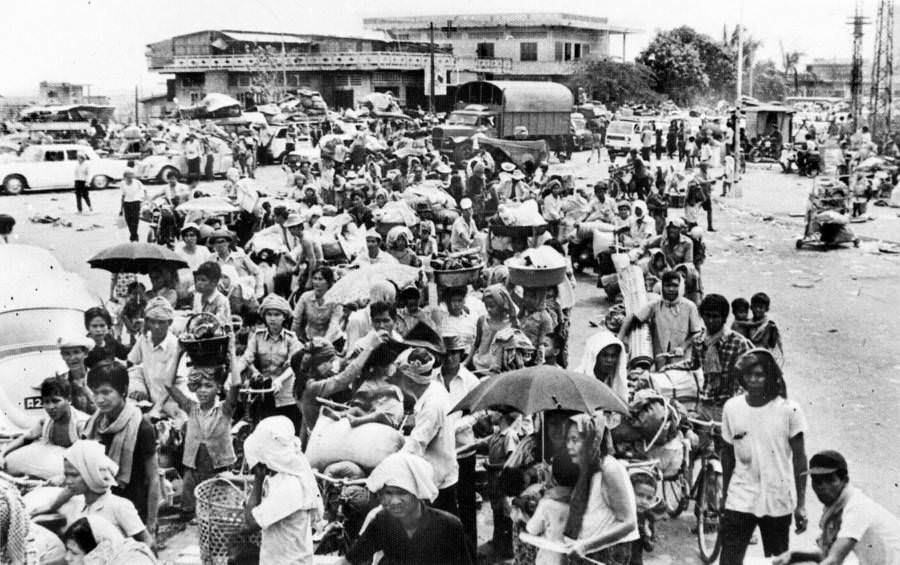
A road leading out of the capital swells with humanity as families and neighbors move together in a tense, crowded stream. In the frame, people clutch bundles, balance baskets, and push bicycles loaded with what they can carry, while a few umbrellas rise above the press of bodies against the harsh light. Cars and trucks are hemmed in by pedestrians, turning the street into a single, slow-moving corridor of escape.
Everywhere the eye lands, the details speak of emergency: children tucked close to adults, improvised loads tied to handlebars, and weary faces looking ahead rather than back. The scene is not a neat evacuation but a mass flight shaped by fear and uncertainty, a hallmark of civil war when ordinary routines collapse overnight. Even the distant buildings feel like silent witnesses as the city’s streets become staging grounds for displacement.
As the title notes, this moment comes from 1975, when thousands of refugees prepared to flee from the Khmer Rouge, leaving behind homes, work, and familiar landmarks for an unknown road. The photograph offers a stark entry point into the broader history of Cambodia’s conflict and the human cost of revolutionary upheaval. For readers searching the history of the Khmer Rouge, the evacuation of the capital, or refugee movements during civil wars, this image anchors the story in the lived reality of a single, crowded day.