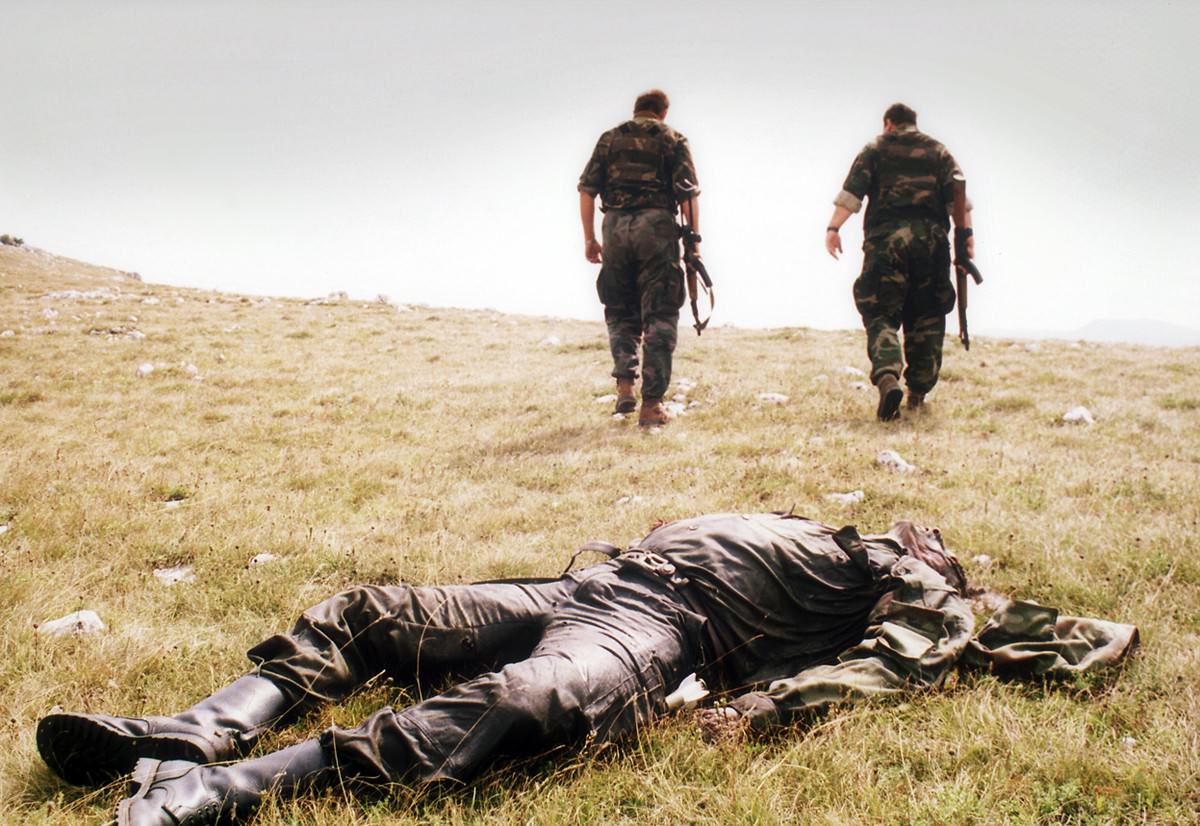
Across a pale, open hillside in western Bosnia, two armed Bosnian Croat soldiers move away from the foreground, their backs turned toward the viewer as the landscape stretches into a washed-out sky. In the grass lies the body of a Bosnian Serb soldier, motionless and partly crumpled, a stark counterpoint to the steady stride of the living. The composition forces the eye to travel from death to distance, turning a simple walk into a heavy procession.
The title situates the scene in the Croatian attack on the Serb-held town of Drvar on August 18, 1995, one of the late-war offensives that reshaped front lines and communities in the region. What the photograph communicates most clearly is the everyday brutality of civil wars: uniforms without faces, weapons carried as routine tools, and a fallen combatant left where he died. The quietness of the terrain—no buildings, no crowds, no smoke—makes the violence feel both immediate and eerily ordinary.
For readers exploring the Bosnian War and the wider Yugoslav Wars, this frame works as a visual reminder of how quickly political aims translate into individual loss. It also raises uncomfortable questions about memory and aftermath: who recovered the dead, who documented the moment, and how such images influence public understanding of the fighting around Drvar and western Bosnia. In its stark simplicity, the photograph becomes both evidence and elegy, capturing the human cost that lingers long after a battlefield has gone quiet.