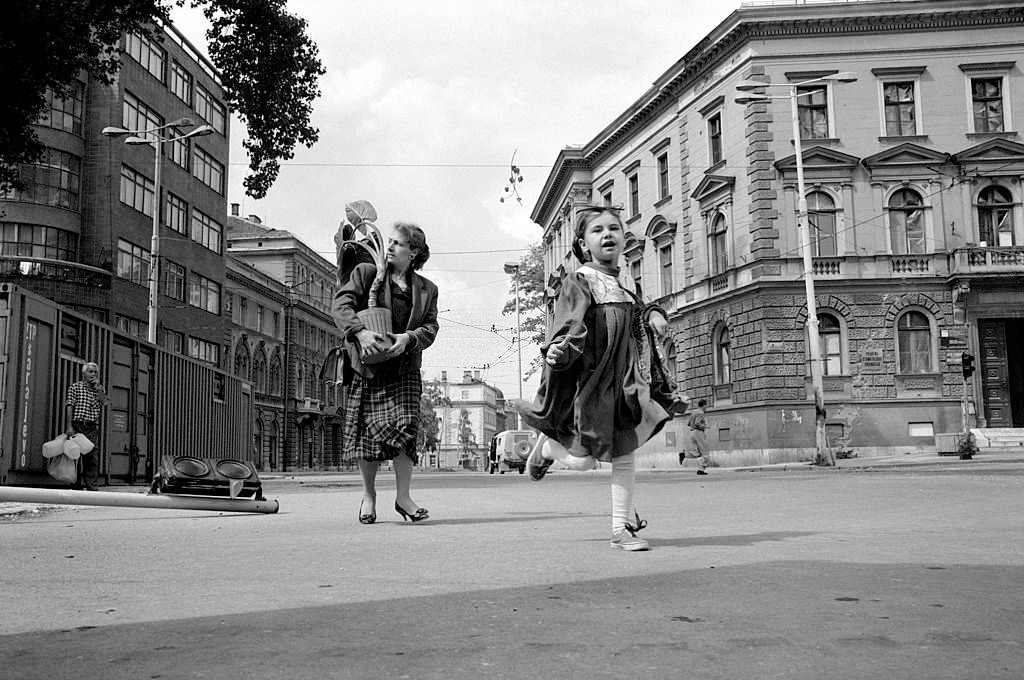
Mid-stride on an exposed city street, a mother grips a potted plant as if it were as essential as food or medicine, her eyes turned to the side in a quick, wary check of the open ground ahead. Just in front of her, a young girl breaks into a run, skirt and cardigan lifting with the motion, the urgency of the moment written into every stretched step. Overhead wires, stark facades, and the emptiness between buildings amplify the sense of risk that gave “Sniper Alley” its grim reputation during civil war.
The details are ordinary—heels on pavement, a plant’s broad leaves, school-like clothes—yet placed in extraordinary circumstances, they become symbols of what civilians try to preserve when violence reorganizes daily life. The houseplant reads as stubborn domesticity carried into the open, a small piece of home transported through danger; the child’s sprint suggests that survival can hinge on seconds. In the background, scattered pedestrians keep distance, and the wide roadway feels less like a boulevard than a corridor where exposure must be minimized.
As a historical photo, the scene speaks to the lived reality of urban siege and the civilian experience of conflict: not only fear and deprivation, but also the persistence of routine, care, and responsibility. The composition draws the viewer across the same vulnerable stretch of street, asking us to notice how architecture and open space can become weapons when snipers control sightlines. For readers searching for “Sniper Alley,” “civil war photography,” or “civilians in wartime,” this image offers an unforgettable glimpse of courage measured in everyday choices—what to carry, when to run, and how to keep moving.