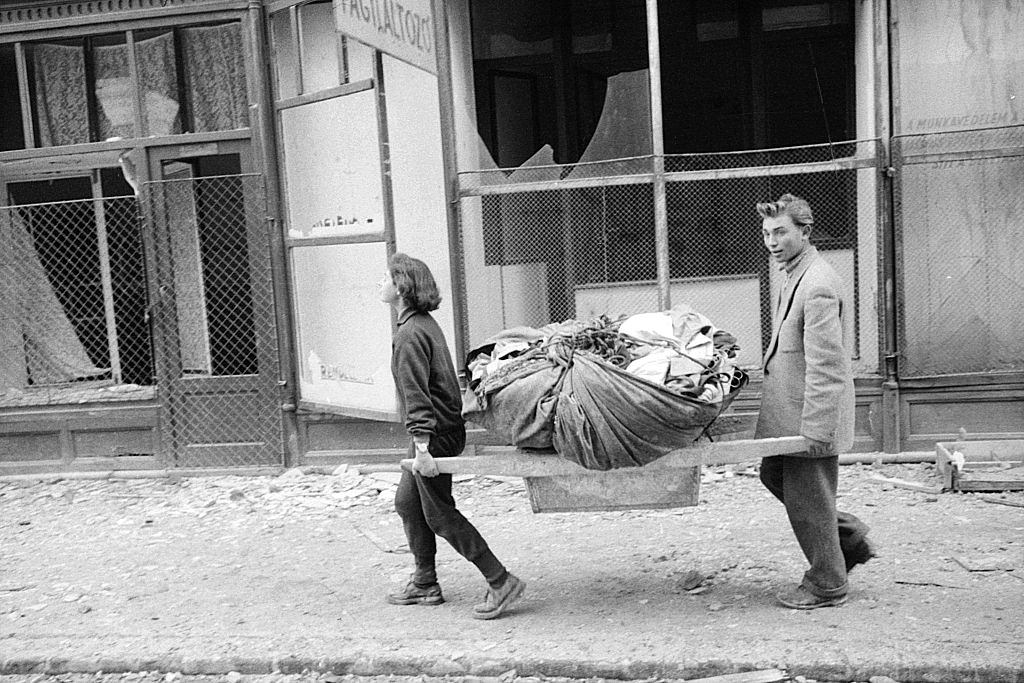
Across a dust-strewn Budapest street on 29 October 1956, two civilians move with the careful coordination of people who have done this before. Between them hangs a long plank bearing a heavy, bundled load—blankets, clothing, and household odds and ends tied into a sagging mass—while shattered glass and rubble crunch underfoot. Behind them, a shopfront with broken windows and exposed interiors turns the everyday cityscape into a jagged backdrop of upheaval.
The strength of the photograph lies in its ordinary detail: work shoes, rolled sleeves, and the practical improvisation of using a board as a stretcher for possessions. Neither figure is dressed like a soldier, yet the scene speaks the language of conflict—scarred buildings, debris-lined pavements, and the sense that safety is temporary. Their faces and posture suggest urgency tempered by routine, as if survival has become a sequence of tasks carried out in public view.
Placed under the stark label of “Civil Wars,” the image resonates as a record of displacement rather than battle, reminding us how revolutions are lived in doorways and streets as much as in headlines. For readers searching the history of the 1956 events in Hungary, this moment offers a grounded perspective on what ruins mean: not just collapsed masonry, but interrupted lives and the quiet work of starting again. It is a hauntingly practical portrait of resilience—two people, one burden, and a city trying to breathe through its broken windows.