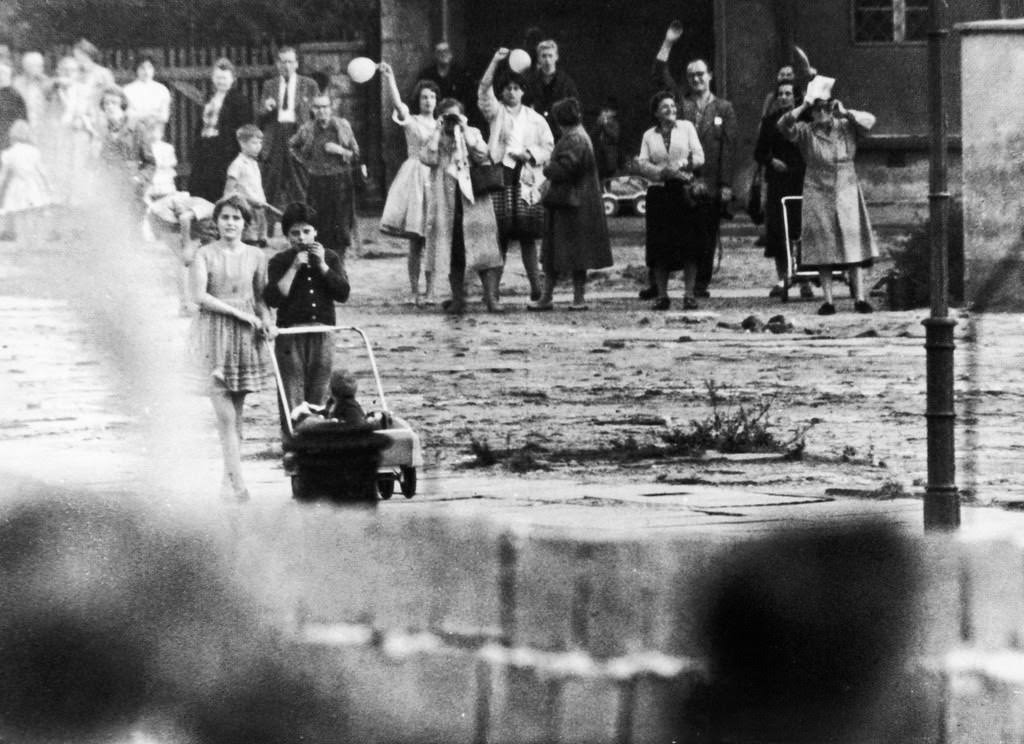
Across a raw strip of ground and a hard barrier, everyday life pauses for a ritual of recognition: hands lifted, faces tilted forward, and a few hurried gestures that must carry the weight of whole conversations. In the foreground, a woman stands with a stroller while a child looks on, and behind them a small crowd gathers, some waving, some shielding their eyes, all trying to be seen from the other side. The Berlin Wall turns a neighborhood into opposing shorelines, where distance is measured not in meters but in permissions denied.
What makes the scene so haunting is how ordinary it remains—street clothes, familiar postures, the casual clustering of people who would otherwise meet at doorways or on the pavement. Yet the ground between them looks stripped and unsettled, emphasizing that this is not a normal street but a contested edge, policed by concrete and fear. The title’s idea of “once neighbors” feels visible here: the body language suggests intimacy and recognition, while the separation imposes a new, enforced formality.
For readers searching the history of the Berlin Wall, Cold War borders, and divided families, this photograph distills the human cost into a single moment of waving across a forbidden line. It echoes the logic of civil conflict without uniforms: communities split, friendships rerouted, and the simplest act—saying hello—reduced to a distant sign. As a historical image for a WordPress post, it invites reflection on how walls reshape cities, memory, and the stubborn desire to remain connected despite the divide.