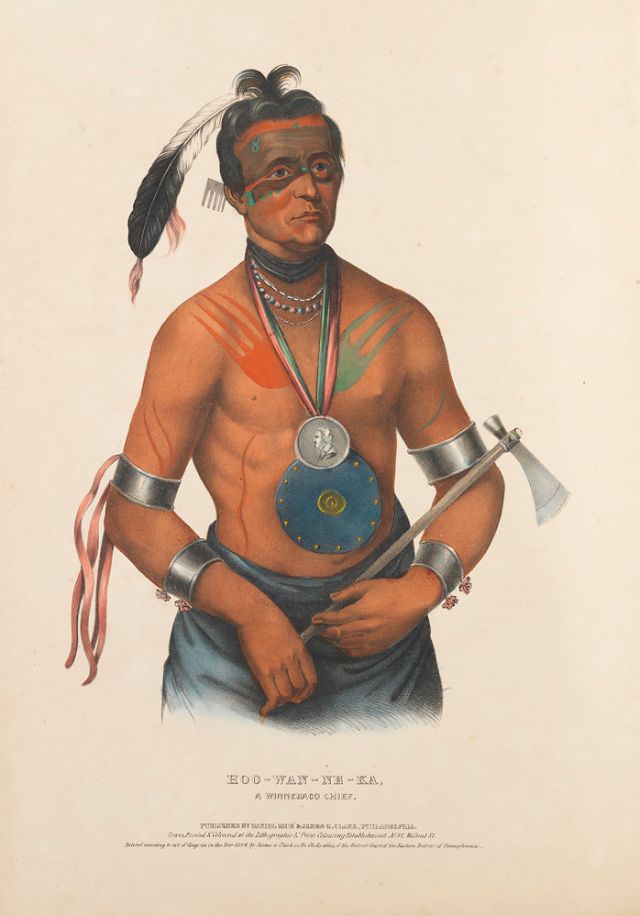
Hoo-Wan-Ne-Ka is presented in a carefully composed portrait that reads as both personal likeness and formal statement. The Winnebago chief faces slightly to one side with a steady, contemplative gaze, his hair gathered and adorned with a long feather that draws the eye upward. Vivid body paint in warm red and cool green accents the face and shoulders, while layered beadwork and prominent medallions hang at the chest, signaling status and ceremony.
Details of material culture stand out throughout the artwork: broad metal armbands and wrist ornaments catch the light, ribbons trail softly at the edges, and a hatchet rests across the forearm with its blade angled toward the viewer. The contrast between skin tones, pigments, and polished metal creates a striking visual rhythm, giving the figure a sense of presence that feels deliberate rather than incidental. Even without a specific setting behind him, the portrait’s clarity invites close reading of every accessory and mark.
For readers interested in Native American history, Winnebago (Ho-Chunk) leadership, and early illustrated portraits, this image offers a window into how Indigenous leaders were depicted for wider audiences. The plain background and centered pose focus attention on identity, regalia, and the artistry of representation, making the print both an aesthetic object and a historical document. Whether you’re browsing for historical artworks or researching Indigenous portraiture, “Hoo-Wan-Ne-Ka, A Winnebago Chief” remains a compelling study in dignity, symbolism, and visual storytelling.