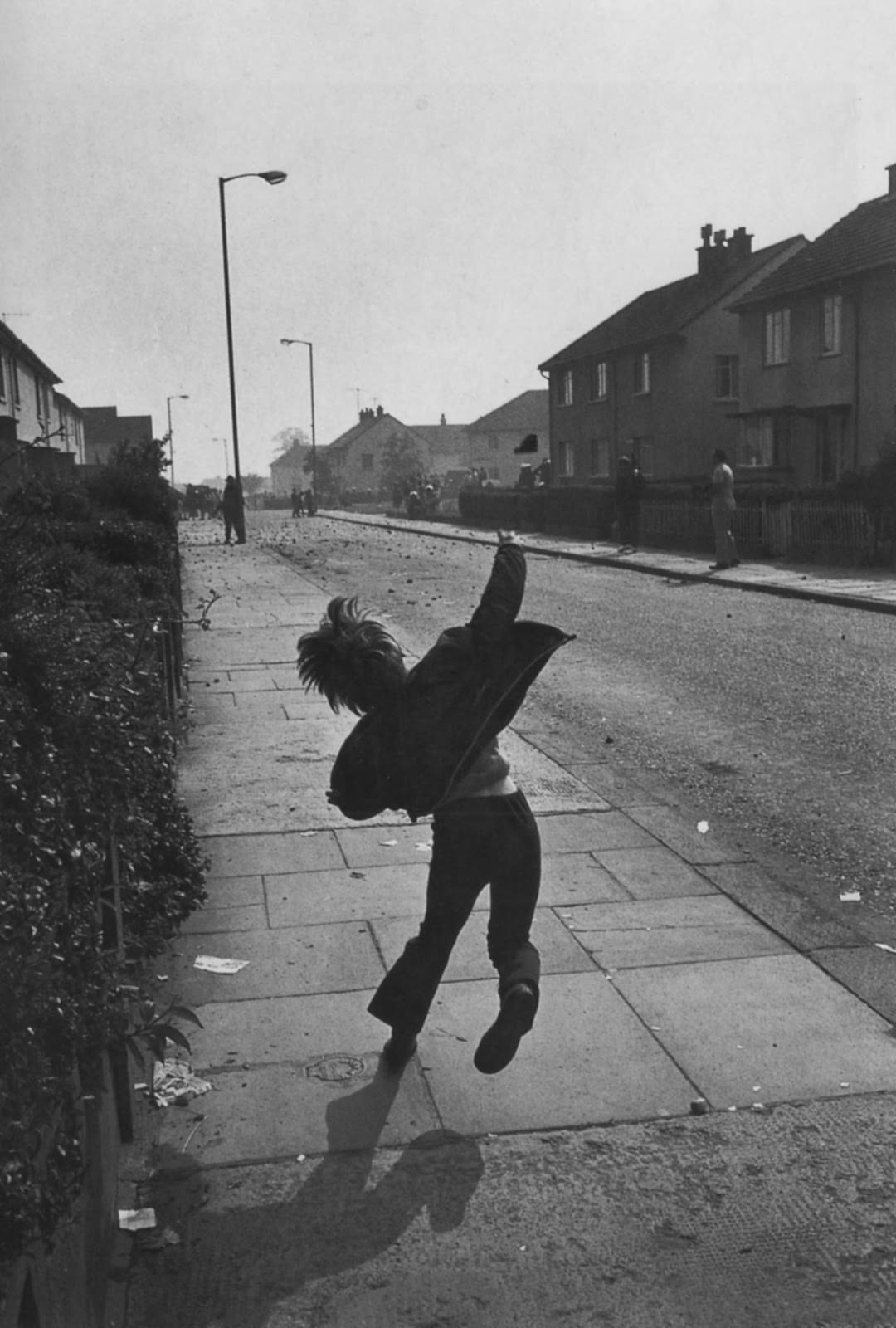
Mid-stride on a quiet residential street, a boy hurls a stone toward a distant line of British soldiers, his body twisted with the urgency of the throw. Lamp posts and low houses recede into the background, while scattered debris on the road hints at earlier clashes and the tense atmosphere of Northern Ireland in 1971. The photographer’s distance compresses the scene into a single, decisive moment: youthful defiance set against disciplined military presence.
In the wider story of the Troubles, images like this have become shorthand for how quickly everyday neighborhoods could turn into front lines. A child’s silhouette in motion, framed by ordinary pavements and garden hedges, underlines the unsettling overlap between domestic life and street confrontation. The title’s stark wording—boy, stones, soldiers, Northern Ireland, 1971—anchors the photograph in a year when unrest and security responses were escalating, and the conflict was increasingly visible to the world.
For readers searching for historical context around civil conflict, British Army deployment, and street protests in Northern Ireland, this photo offers a powerful entry point without needing sensationalism. It invites reflection on how communities experienced authority and resistance at ground level, and how the camera can freeze both vulnerability and anger in the same gesture. More than a record of a single incident, it stands as a reminder of how political violence can shape childhood, memory, and the visual history of the Troubles.