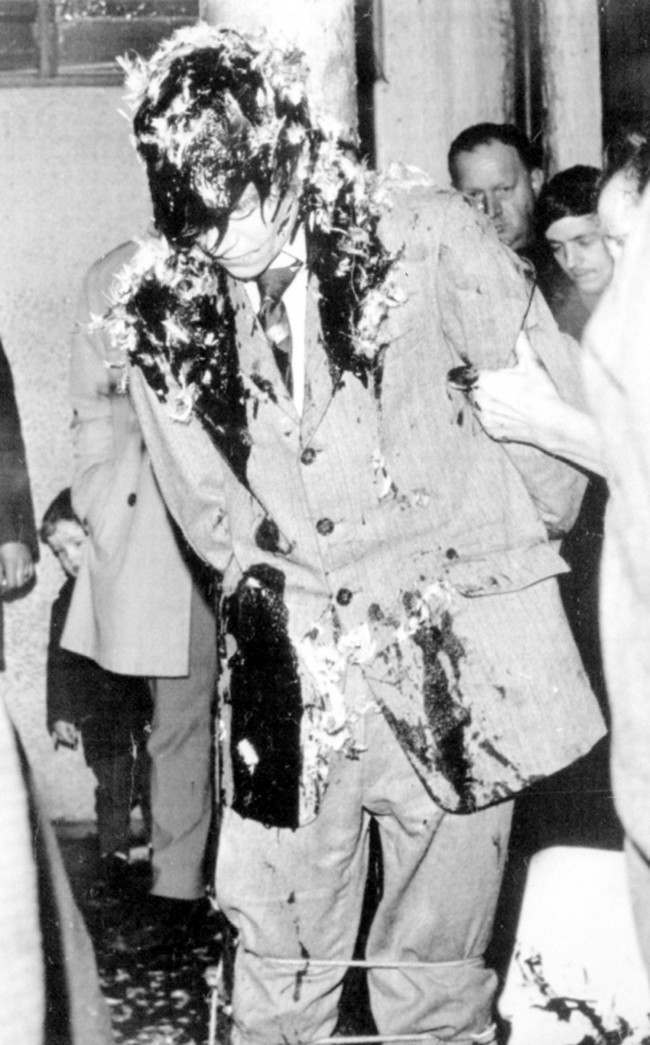
Under the harsh glare of street lighting in Belfast’s Falls Road area, a young man stands bound and bowed, his suit and hair clotted with tar and stuck with feathers. The camera’s flash turns the mess into a slick, almost metallic sheen, while his downcast face and slack posture speak louder than any caption. Behind him, close-packed onlookers hover in a narrow space, their expressions tense and watchful, as if the scene is both spectacle and warning.
Dated 10 January 1971, the title notes he was one of three youths subjected to the same punishment within twenty-four hours, a grim measure of how quickly intimidation could ripple through a community. Tar-and-feathering, an older form of public humiliation, appears here not as folklore but as lived reality—violence staged for maximum visibility. The lamp post becomes an improvised pillory, turning an ordinary streetscape into a theatre of control.
For readers tracing the history of civil conflict and street-level enforcement during the Troubles, this photograph offers an unvarnished glimpse of coercion beyond official policing. Details like the tied legs, the ruined clothing, and the gathered crowd underscore how punishment could be made public, personal, and immediate. As a historical record, it forces attention onto the human cost of factional power and the ways fear was manufactured in the everyday spaces of Belfast.