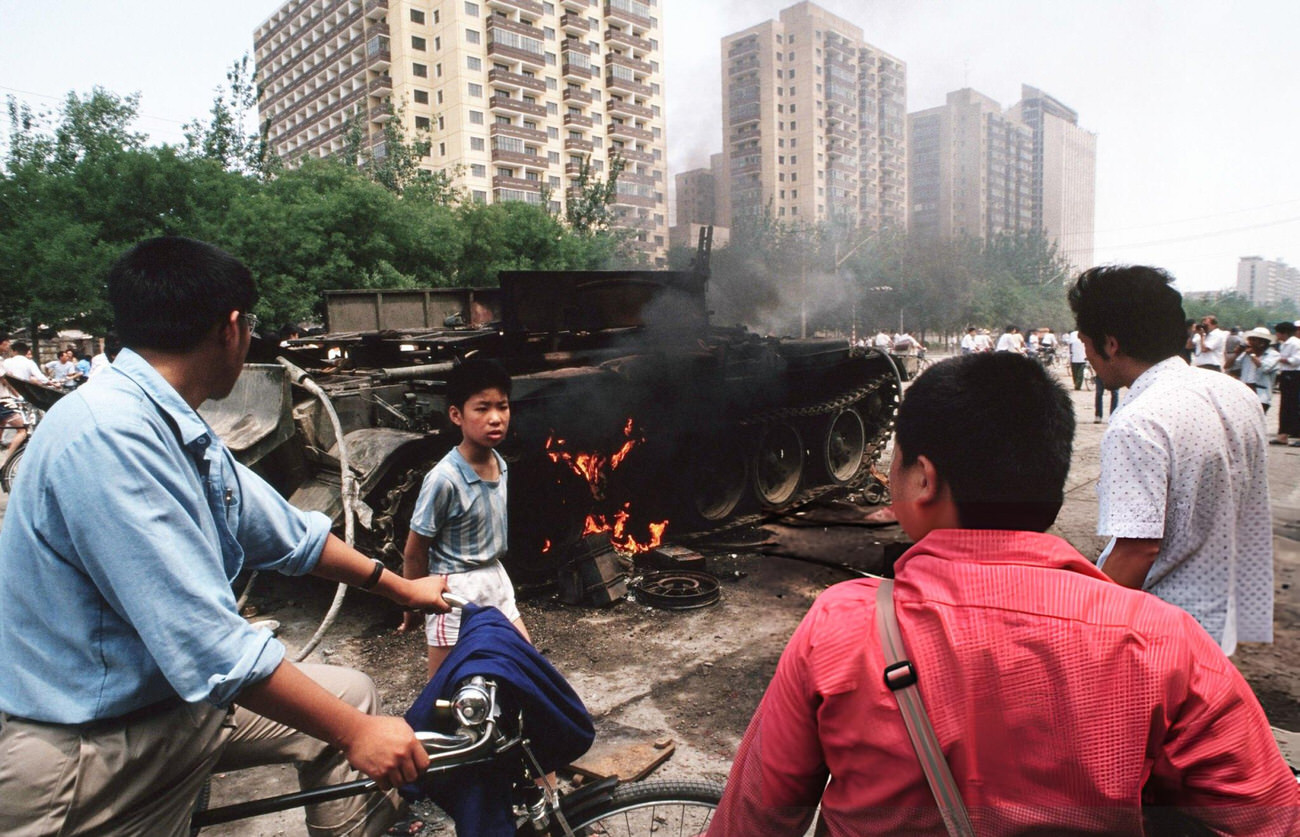
Smoke still hangs over a broad city street as onlookers gather around the charred remains of Chinese Army trucks and other vehicles, their twisted metal frames sprawled across the roadway. A small flame licks at debris near the undercarriage while people edge closer—some on foot, one astride a bicycle—studying the wreckage with the wary curiosity of those who arrived just after the worst had passed. In the background, tall apartment blocks and a line of trees loom like silent witnesses, grounding the scene in an everyday urban landscape now interrupted by destruction.
Crowds form a loose perimeter, and the faces turned toward the burned-out hulks suggest a mix of shock, uncertainty, and grim attention to detail. The contrast between ordinary clothing and military hardware emphasizes how quickly public space can become a contested stage during political unrest and civil conflict. Details such as scattered parts, blackened paint, and lingering smoke provide a stark visual record of violence without needing a single spoken explanation.
Taken in 1989, the photograph offers a sobering window into a moment when power, protest, and the machinery of the state collided in public view. For readers searching for historical photos of China in 1989, Chinese Army vehicles, or images of damaged military trucks in urban streets, it serves as an immediate, unsettling document. It also reminds us that history is often preserved not only in official accounts, but in the tense, crowded aftermath—when ordinary people step forward to look, to remember, and to make sense of what has just occurred.