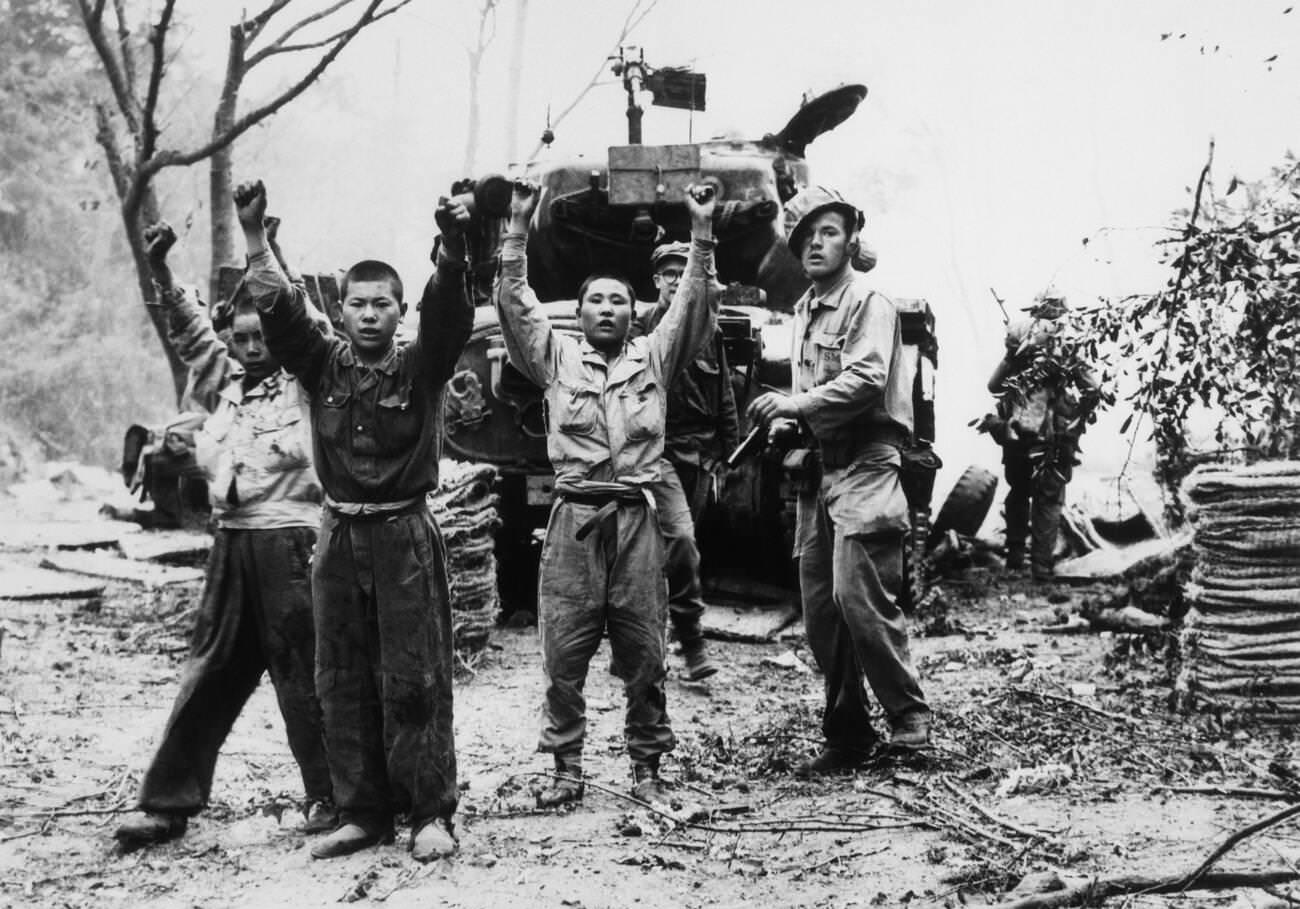
Arms raised high in surrender, a small group of North Korean prisoners of war stands in the foreground while a U.S. Marine keeps watch at close range, rifle in hand. Behind them looms an armored vehicle, its bulk filling the road and hinting at the firepower that dominated many late-war encounters. The scene is tense but controlled, frozen at the moment when combat gives way to custody.
The photograph’s details pull you into the rough texture of the Korean War battlefield: churned earth underfoot, bare branches and scrub at the roadside, and the improvised look of gear and clothing. The prisoners’ worn jackets and loose trousers contrast with the Marine’s field uniform, a visual reminder of the unequal circumstances that often defined capture and survival. Even without a visible horizon or clear landmarks, the setting feels like a contested corridor—one more hard-won stretch of ground in a war of ridgelines, roads, and sudden contact.
Titled “US marine capturing North Korean prisoners of war, 1953,” this image speaks to the war’s closing phase, when negotiations and fighting overlapped and surrender could occur amid continuing danger. It is also a stark document of the human side of military history: fear, authority, and the fragile transition from enemy combatant to prisoner. For readers exploring Korean War history, U.S. Marines, POW experiences, or Cold War-era conflicts, the photo offers a direct, unsettling glimpse of what “civil wars” and international wars alike can do to ordinary lives.