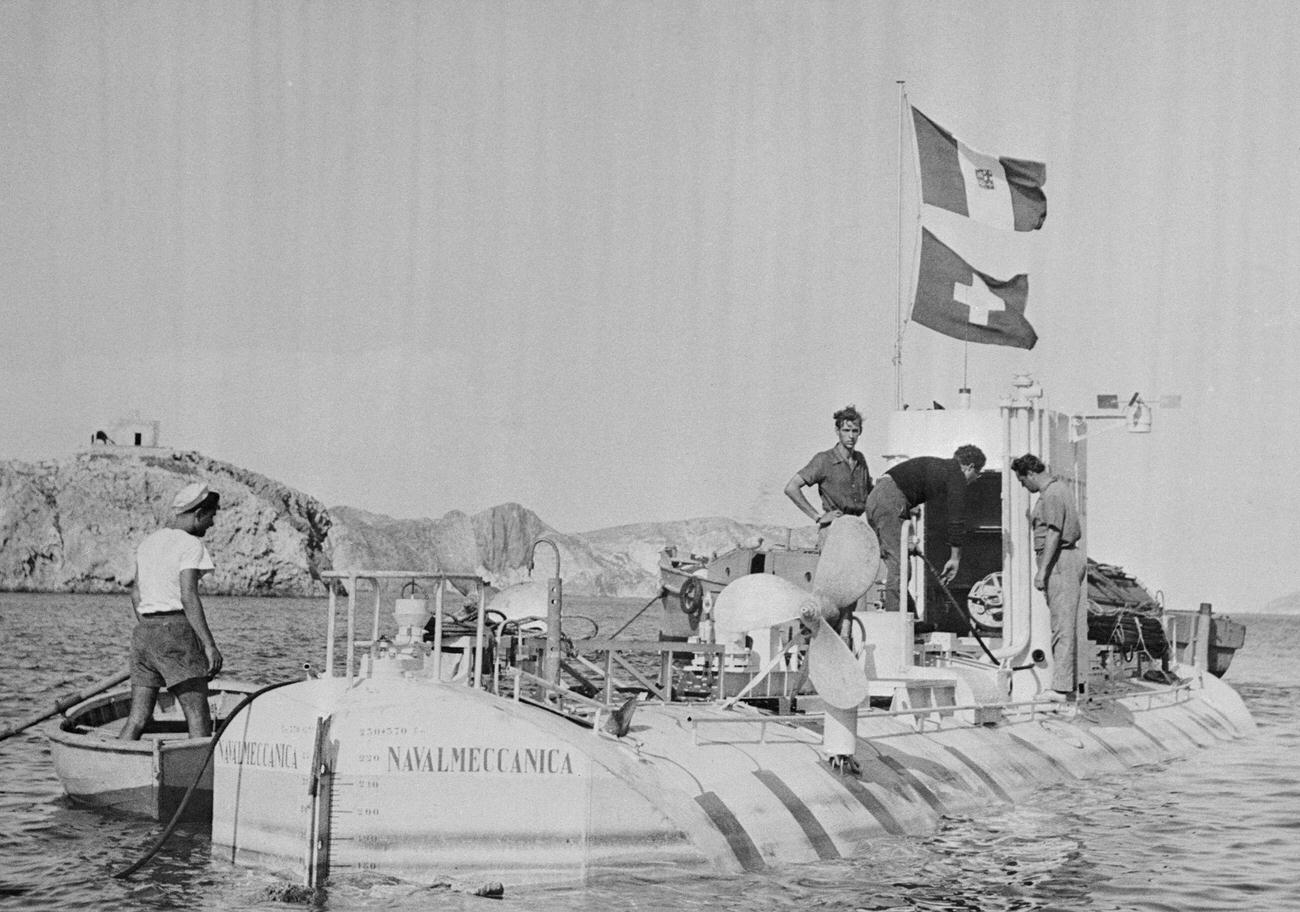
Against a stark seascape and distant rocky hills, the bathyscaphe Trieste sits low in the water as crew members move across its cramped deck, tending to hatches and fittings with the brisk focus of a high-stakes test. Two flags flutter above the vessel, while the rounded hull and exposed framework hint at a machine built for a single purpose: to survive where sunlight and ordinary ships cannot. Details like the propeller, cables, and compact platform make the scene feel both improvised and intensely modern—an inventions-era workshop launched onto open water.
Auguste Piccard’s association with Trieste evokes the turning point when deep-sea exploration became an engineered challenge rather than a sailor’s tale. The bathyscaphe’s distinctive form—part buoyant float, part pressure-resistant cabin—speaks to the physics of descent, where crushing pressure demands radical design choices and meticulous preparation. Seen here at the surface, the craft looks almost modest, yet the title’s promise of a new underwater depth record underscores how extraordinary its mission really was.
For readers drawn to the history of technology, oceanography, and record-setting expeditions, this photograph offers an authentic window into mid‑20th‑century innovation at sea. It’s a moment of calm before the plunge, when human hands still touch every valve and panel, and success depends on teamwork as much as theory. As a WordPress feature image or archival post, it pairs beautifully with discussions of bathyscaphes, deep-diving engineering, and the long quest to reach the ocean’s greatest depths.