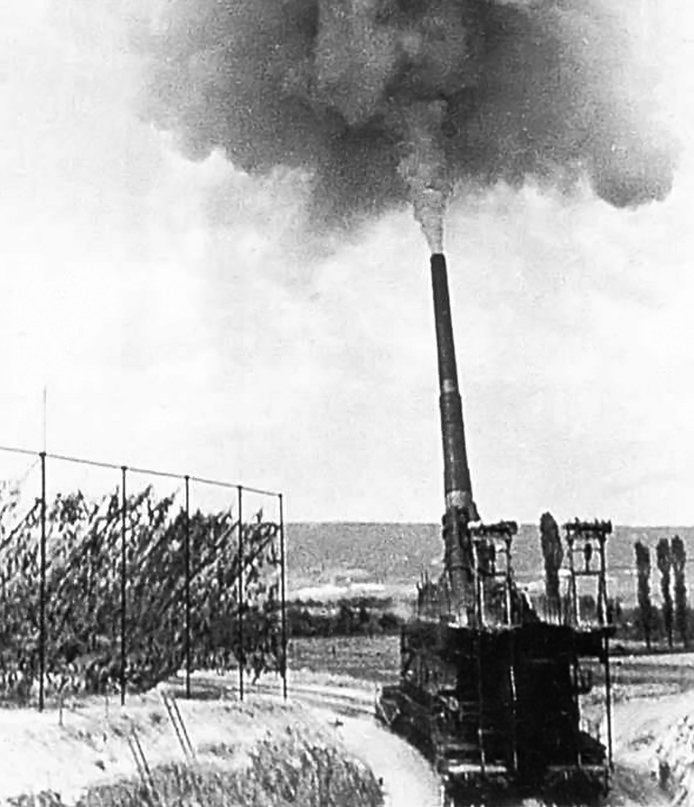
A towering artillery barrel rises from a rail-mounted platform, its muzzle crowned by a thick bloom of smoke that blurs the sky and hints at the violence of the shot just fired. The surrounding landscape looks almost ordinary—flat ground, sparse vegetation, and utilitarian structures—until the sheer scale of the weapon pulls everything into perspective. Even in grainy wartime photography, the Gustav Gun reads less like a battlefield tool and more like an industrial monument.
Behind the spectacle lies a distinctive kind of engineering ambition: the push to turn factories, rail lines, and heavy machinery into a single, moving weapons system. The rail carriage, the support frames, and the carefully staged firing position suggest how much planning and manpower were required simply to operate such an oversized gun. That logistical burden is part of what makes Nazi engineering inventions so arresting to study—technical prowess paired with a destructive purpose, and a constant trade-off between awe-inspiring scale and practical military value.
For readers interested in WWII superweapons, German heavy artillery, and the history of wartime technology, this historical photo invites a closer look at how propaganda, innovation, and industrial capability intersected. The Gustav Gun stands as an astonishing relic not only for its size, but for what it reveals about priorities and imagination under a regime that poured resources into extremes. Seen today, it remains a stark reminder that engineering achievements are never neutral; they inherit the intentions of those who commission them.