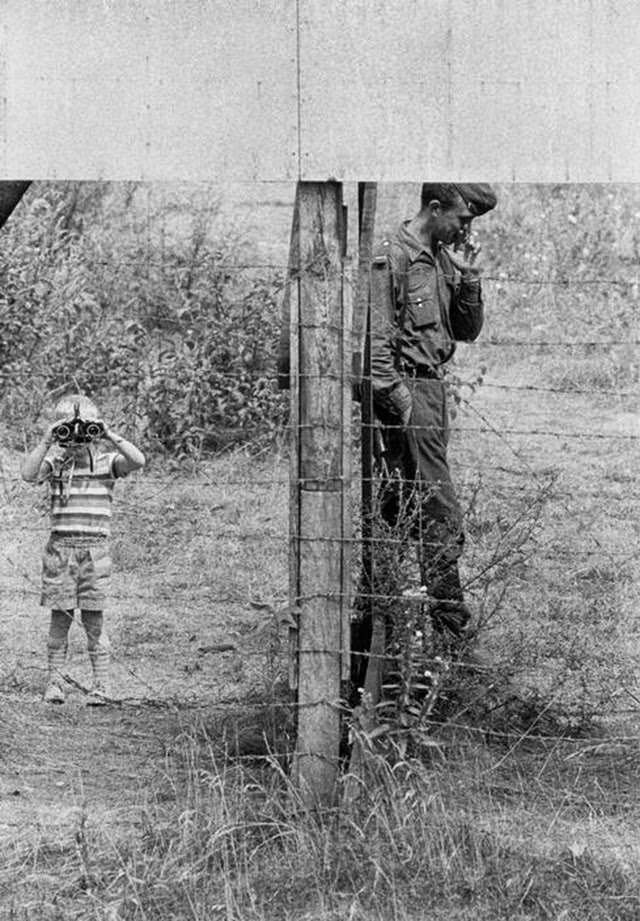
On a scrubby strip of ground beside a barbed wire fence, a small boy stands with binoculars raised to his face, intent on the world beyond the barrier. His striped shirt and short trousers make him look almost like he’s on an outing, yet the setting is unmistakably the Berlin border between East and West. Nearby, an East German border guard leans against a post, watchful and withdrawn, turning an ordinary moment into a quiet study of division.
The contrast is what lingers: childhood curiosity set against a uniformed presence and the hard geometry of wire and stakes. The boy’s gaze into West Berlin suggests how close the other side could feel—visible, imaginable—while still kept out of reach by policy and patrol. In the guard’s posture there’s fatigue or contemplation, a reminder that the Cold War was lived day by day by individuals as much as it was waged in headlines.
For readers interested in Berlin Wall history, East Germany, and everyday life along the Iron Curtain, the scene offers more than a dramatic symbol; it shows how borders seeped into play, routine, and even simple acts of looking. The fence slices the landscape and the frame, yet the human interaction around it softens the edges without erasing the threat. That uneasy balance—between normality and coercion—helps explain why images from the East–West Berlin border still resonate so strongly today.