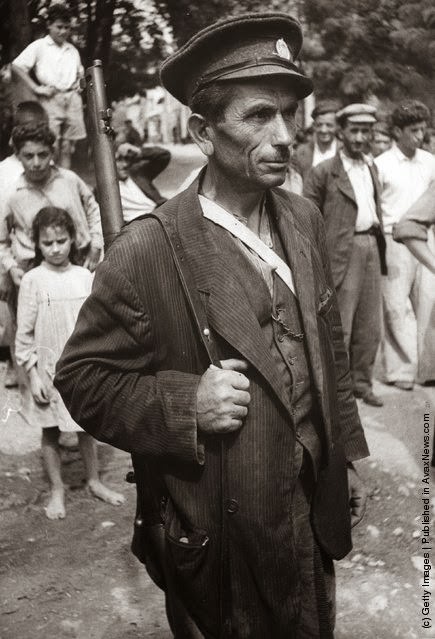
A lone Home Guard stands in the foreground at Goumenissa, Macedonia, his cap pulled low and his expression set with the weary alertness of a man living through sudden violence. He grips a rifle slung along his shoulder, while his worn jacket and layered clothing hint at a life split between ordinary routines and emergency duty. The moment feels caught mid-breath, as if the raid has just passed and the next alarm could come at any time.
Behind him, villagers gather in a loose ring—men in work clothes and caps, a barefoot child at the edge—forming a quiet audience to the aftermath. Their faces read as cautious rather than dramatic, suggesting shock tempered by familiarity with hardship. Trees and open ground frame the scene, giving it the look of a town street or communal space where public life continued even as the Greek Civil War pressed into daily existence.
Set in 1947, the title’s reference to an Andartes raid places the photograph within the tense, localized struggles that defined the conflict in northern Greece. Images like this remind readers that civil wars are often experienced not in grand battle lines but in neighborhoods, farms, and small-town squares, where security depended on improvised forces and fragile trust. For those researching the Greek Civil War, Home Guard units, or life in Macedonia during the period, this portrait offers a stark, human-scale entry point into a turbulent chapter of modern history.