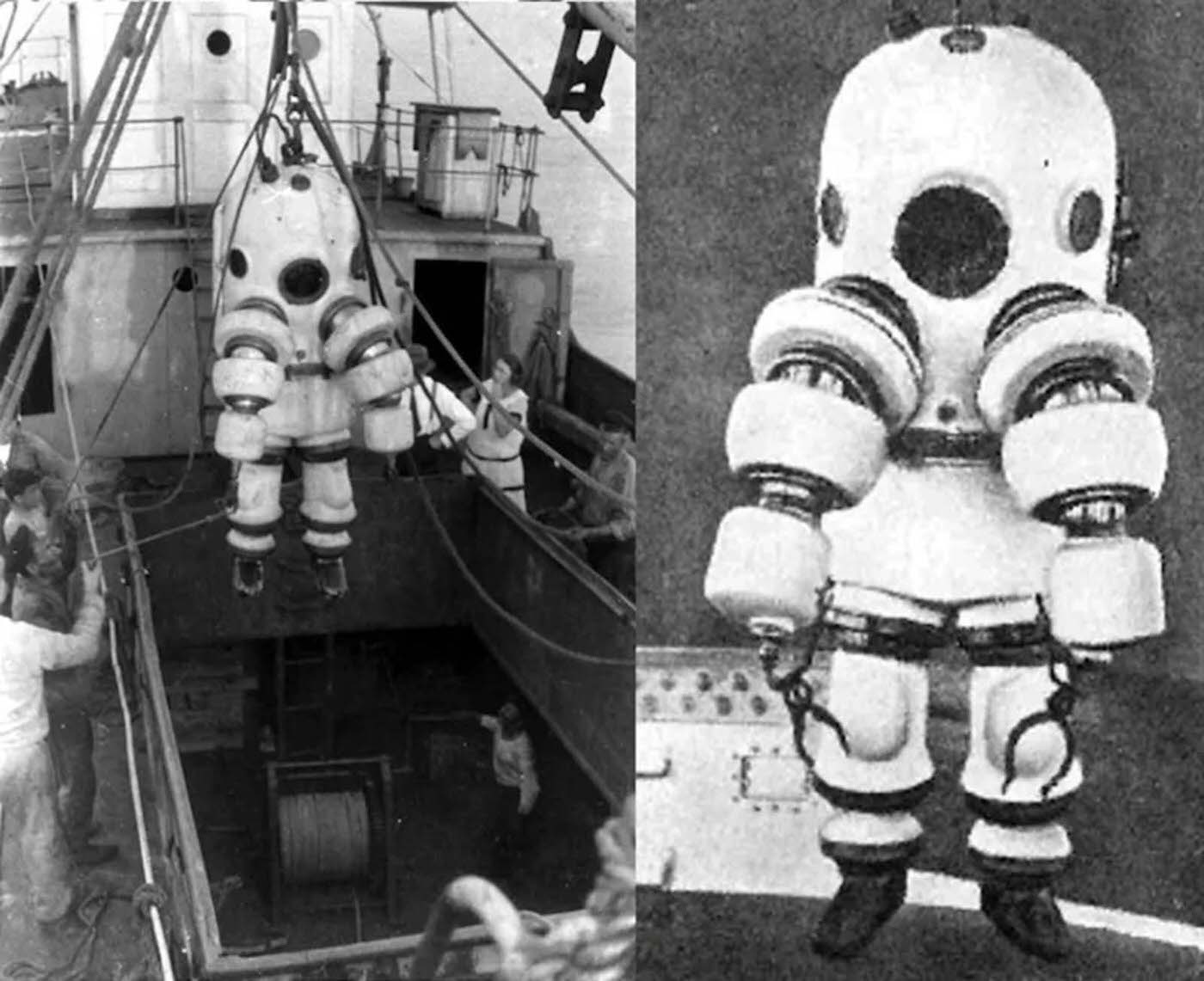
Suspended by a ship’s rigging, the Neufeldt-Kuhnke diving suit hangs like a mechanical bell, its rounded helmet punctuated by circular viewing ports and surrounded by bulky canisters and couplings. Crew members stand nearby on deck, emphasizing the apparatus’s scale and the careful choreography required to move it into position. The industrial setting—cables, winches, and hard edges of the vessel—frames the suit as working equipment rather than a novelty, built for serious underwater tasks.
Alongside the shipboard scene, a closer view isolates the suit’s distinctive silhouette: a smooth, domed headpiece with porthole-like windows and paired cylindrical units mounted at the chest and sides, feeding air and managing pressure. Heavy joints and reinforced boots suggest the challenges of walking on a seabed, while the external hoses and fittings hint at the lifeline connecting diver and surface. Even without labels in the frame, the design reads as early twentieth-century engineering—practical, modular, and unapologetically robust.
Between 1917 and 1922, inventions like this reflect a period when deep-sea work was expanding beyond experimentation into organized operations, and the safety of a diver depended on dependable hardware as much as skill. For readers interested in vintage diving technology, maritime history, and the evolution of underwater exploration gear, this photo offers a tangible look at how engineers tried to solve the ocean’s most persistent problems. The Neufeldt-Kuhnke suit stands as a reminder that progress often arrives in heavy metal, carefully sealed seams, and the steady pull of a crane lowering innovation toward the water.