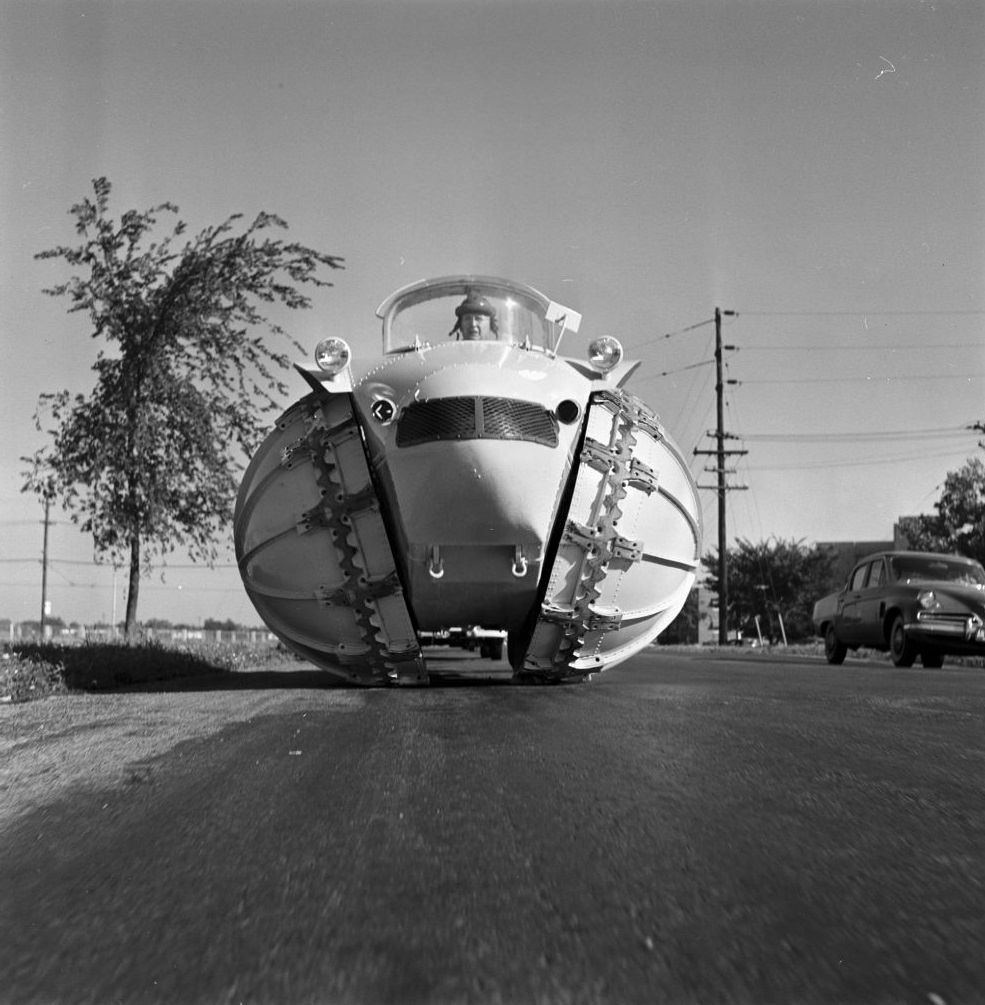
Rolling toward the camera like something borrowed from a science-fiction serial, the four-wheel vehicle nicknamed “Rhino” turns the ordinary roadway into a proving ground for invention. Its most striking feature is the pair of hemispheric wheels—bulbous, segmented shells that make the machine look part car, part armored craft. A driver sits high behind a curved windscreen, framed by headlamps and a blunt nose that suggests the designer cared as much about presence as performance.
What those rounded wheels hint at is an era of restless experimentation in transportation, when engineers and tinkerers alike chased better traction, smoother rides, and safer handling on imperfect roads. Instead of thin rubber tires, the Rhino’s unusual rolling geometry seems built to climb over ruts and obstacles, spreading weight and gripping the surface in a way conventional wheels cannot. The photo’s low angle emphasizes mass and momentum, inviting the viewer to imagine how such a contraption would feel as it rumbled, rocked, and steadied itself down the street.
Alongside a regular car in the background, the Rhino reads as a bold “what if?”—a reminder that progress is rarely a straight line. Some inventions become everyday essentials; others remain fascinating detours that reveal the ambitions and anxieties of their time. For readers interested in vintage technology, experimental vehicles, and the history of automotive design, this image offers a memorable glimpse of ingenuity on display, captured mid-test on an open road.