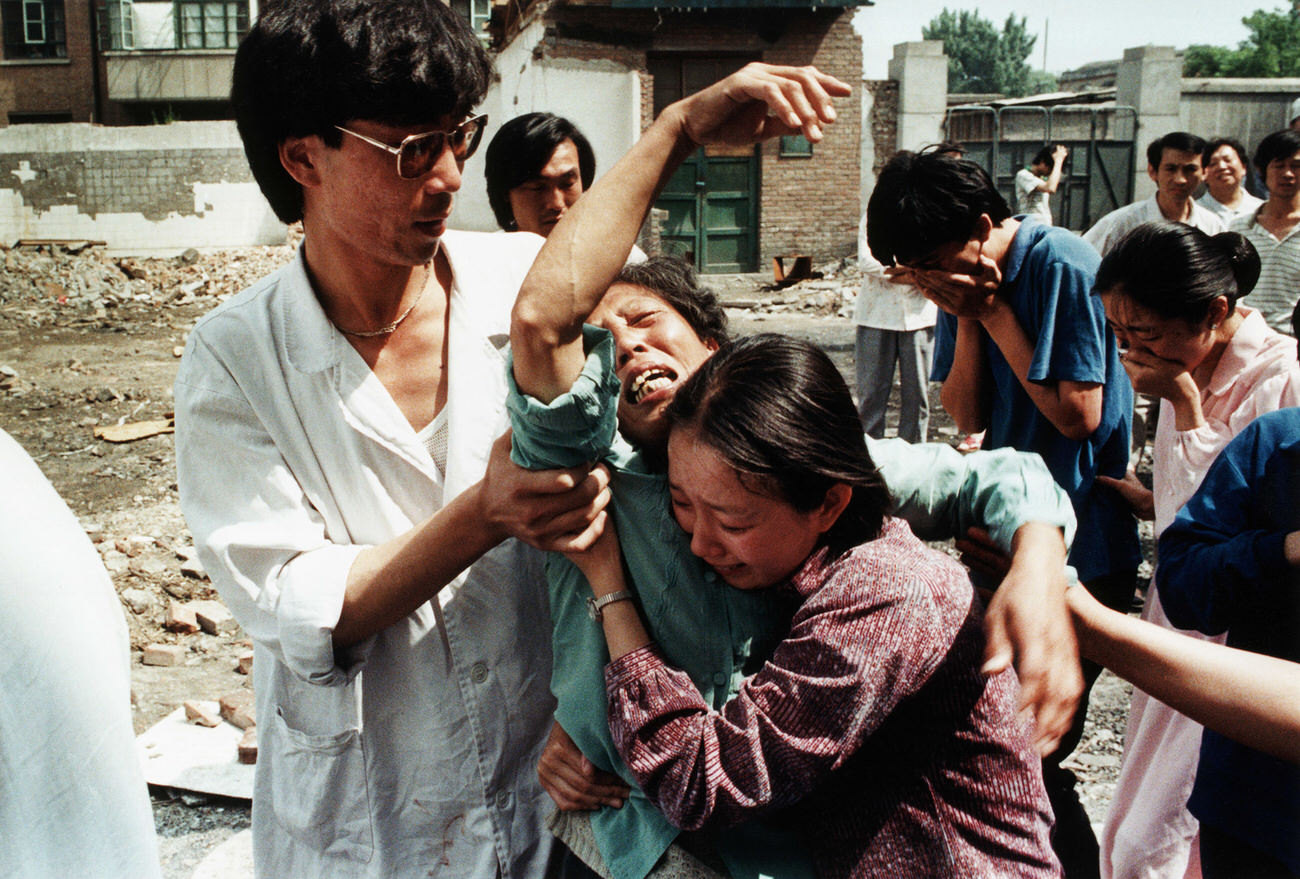
Grief erupts in the open air as relatives and neighbors press close around a mother who can barely stand, her face twisted with shock while one arm flings upward in a helpless, instinctive gesture. A man in a white shirt grips her forearm to keep her from collapsing, and another woman braces her from the front, cheek to shoulder, as if holding together a body shattered by news. In the background, others cover their mouths and eyes, their posture mirroring the same sudden, private devastation made public.
The setting is stark and ordinary—an unadorned courtyard edged by brick walls, broken ground, and scattered debris—yet it becomes a stage where the cost of political violence is unmistakable. The title’s context of a student protester killed by soldiers sharpens the meaning of every detail: the tightened hands, the bowed heads, the way onlookers hover at a distance, unsure whether to step in or step back. Rather than battlefields or uniforms, the photograph centers the civil war of the heart, where loss arrives not with fanfare but with a sentence delivered and a life forever divided into before and after.
For readers searching the history of civil wars, protest movements, and state repression, this scene offers a powerful reminder that the aftermath is measured in families, not slogans. The camera lingers on collective mourning—comfort offered in hurried grips and full-body embraces—showing how communities absorb trauma together when one household is struck. As a historical photo for a WordPress post, it invites reflection on memory, accountability, and the human consequences of crackdowns on student protest, without needing a caption full of names to speak its truth.