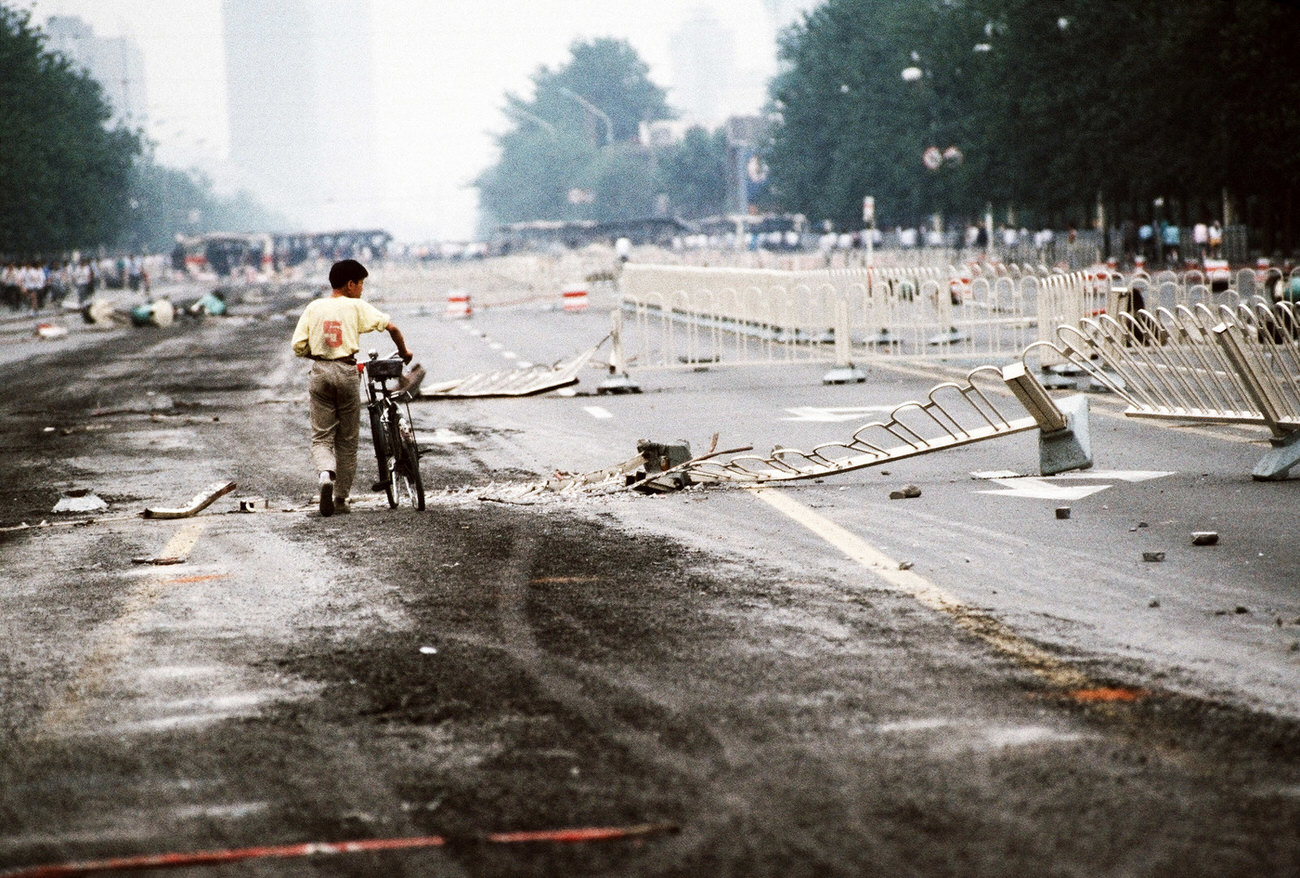
Morning haze hangs over Changan Avenue as a lone cyclist moves on foot, guiding his bicycle through a roadway scarred by the night’s violence near Tiananmen Square. The broad boulevard—normally a symbol of order and movement—looks abruptly emptied, its asphalt darkened and littered with debris. A small figure in the foreground becomes the measure of the scene’s scale, dwarfed by the width of the street and the silence that follows upheaval.
Crushed street barriers lie twisted along the lane lines, bent metal and broken segments pointing to the force that passed through. Rows of intact railings still stand in places, creating a jagged contrast between control and collapse, while scattered objects and torn material mark where people and vehicles recently clashed. In the distance, indistinct shapes and a thin line of onlookers suggest a city holding its breath, watching what comes next.
Stories of civil conflict are often told through crowds, banners, or speeches, yet this frame narrows history to one ordinary passage through extraordinary wreckage. The image speaks to the aftermath of military power on an urban street, and to the quiet persistence of daily life trying to resume amid smashed barricades and uncertain aftermath. For readers searching Tiananmen Square aftermath photos, Changan Avenue street barriers, or visual records of state violence and resistance, this photograph offers a stark, human-scale doorway into the memory of that night.