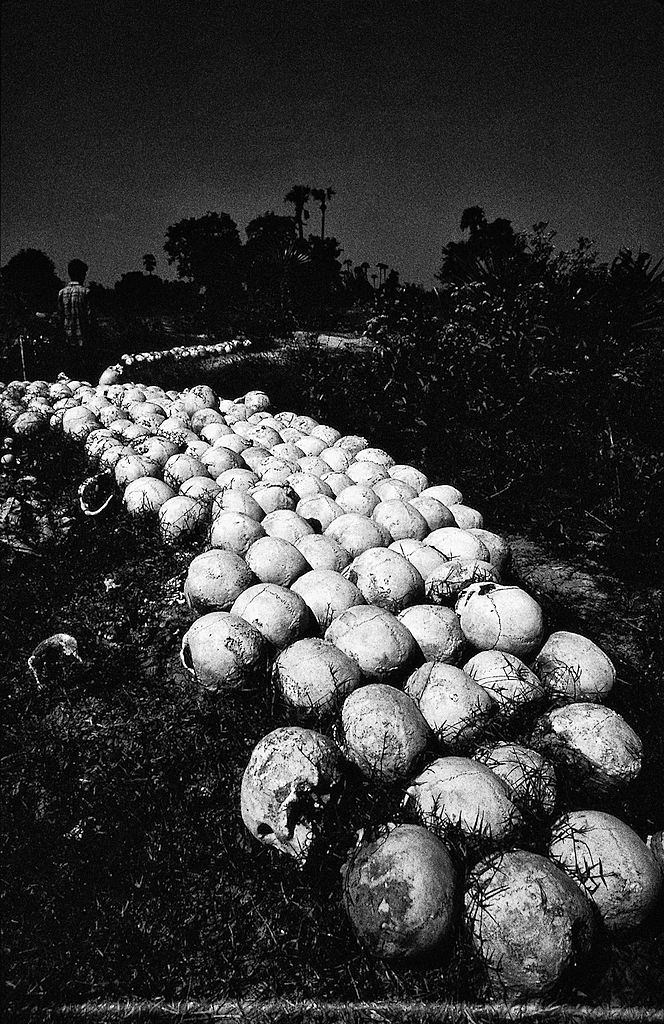
Rows of human skulls lie in the grass at Choeung Ek, the Cambodian “Killing Fields” located just a few kilometers south of Phnom Penh. The stark contrast of pale bone against dark earth makes the scene feel both forensic and intimate, turning the landscape itself into a witness. In the distance, small figures and tree silhouettes recede into the horizon, underscoring how ordinary surroundings can hold extraordinary trauma.
Choeung Ek is remembered as one of the most haunting sites tied to Cambodia’s civil wars and mass violence, a place where lives were reduced to statistics and then, cruelly, to remains. The photograph’s low angle draws the eye along the uneven line of skulls, emphasizing repetition—loss multiplied many times over—while weeds and soil reclaim the space. Nothing here needs embellishment; the quiet arrangement speaks with a weight that words struggle to match.
For readers searching to understand the history of Phnom Penh, the Khmer Rouge era, and the legacy of genocide memorials in Cambodia, this image offers an unfiltered confrontation with aftermath. It also raises difficult questions about memory, documentation, and how societies rebuild when violence has been systematic. Visiting—or even viewing—Choeung Ek through photographs like this can be a form of remembrance, insisting that the victims are not forgotten even when the world moves on.