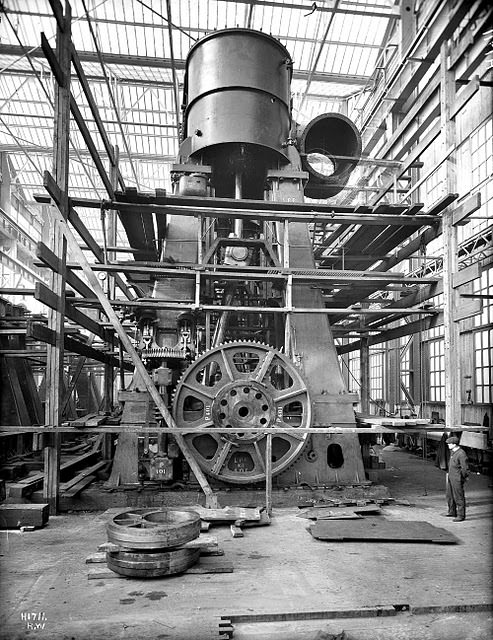
Towering over the workshop floor, a massive piece of marine machinery stands framed by scaffolding, girders, and a high industrial roof that floods the space with light. The scale is immediately apparent: a lone worker near the base looks almost miniature beside the great wheel and heavy housings, while loose rings and parts lie ready for fitting in the foreground. Details like riveted plates, wide openings, and the rigid symmetry of the assembly evoke the era when shipbuilding was as much about iron discipline as it was about daring ambition.
Inside such engine shops, the Titanic’s “unsinkable” reputation was forged as much by engineering confidence as by marketing. This scene speaks to the inventions and improvements that defined early 20th-century ocean liners—powerful propulsion systems, precision-machined components, and factory organization capable of producing machinery on a truly colossal scale. Even without a visible ship’s hull, the industrial setting tells the story of how modern mass production and meticulous craftsmanship met to build the machines meant to drive the world’s largest liners across the Atlantic.
For readers searching Titanic construction history, shipyard engineering, or the technology behind famous ocean liners, this photograph offers a grounded look at the work that made the legend possible. The air of the shop—orderly yet intense—suggests the countless hours of fitting, measuring, and testing that went into every moving part. Seen today, it’s a reminder that the Titanic’s rise to fame began long before launch day, in cavernous halls where invention, labor, and scale combined to chase a new standard of maritime power.