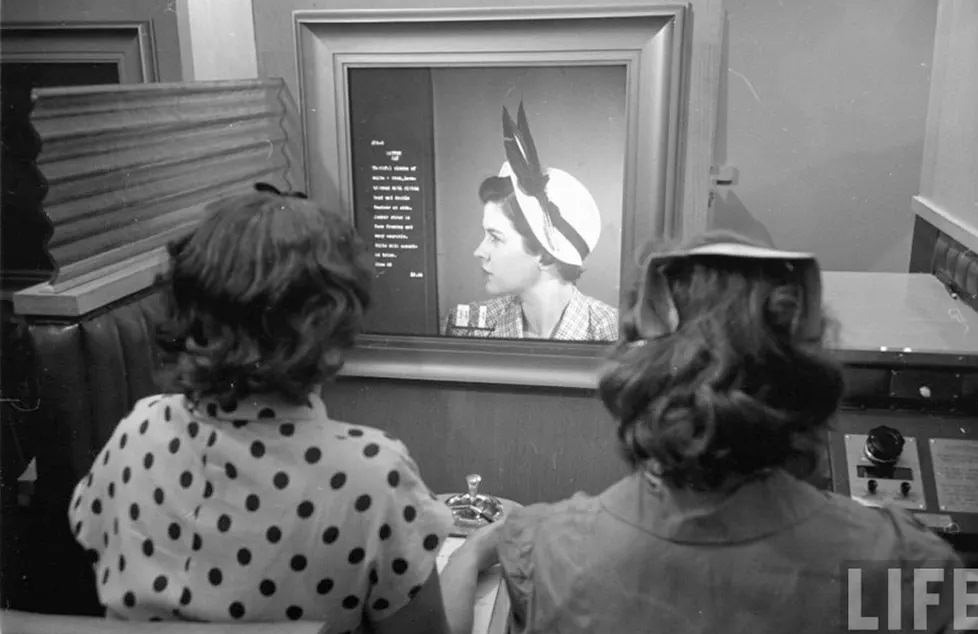
Two shoppers sit shoulder to shoulder in a booth-like space, their attention fixed on a glowing screen that looks more like a framed display than a modern monitor. On it, a model’s profile appears beside a neat column of text, hinting at categories, options, or a menu of goods—an early attempt to turn browsing into something you could do electronically. The setting feels half café, half demonstration kiosk, where the novelty of “ordering from the screen” was part of the experience.
Long before the web made e-commerce routine, companies experimented with pre-internet online shopping systems that promised convenience through terminals, video displays, and centralized fulfillment. Instead of walking aisles, customers could select products from an on-screen catalog, then rely on the business to package and ship their choices to the home. Seen through today’s lens, it reads as a prototype of the online store: limited bandwidth in every sense, but full of ambition.
Details like the customers’ posture—leaning in, studying the display—capture the moment when retail began shifting from physical shelves to information on a screen. That quiet act of choosing, mediated by technology and completed by delivery, foreshadows everything from home shopping networks to modern app-based checkout. For readers interested in inventions and retail history, this photo is a reminder that “online shopping” had a long runway before the internet made it universal.