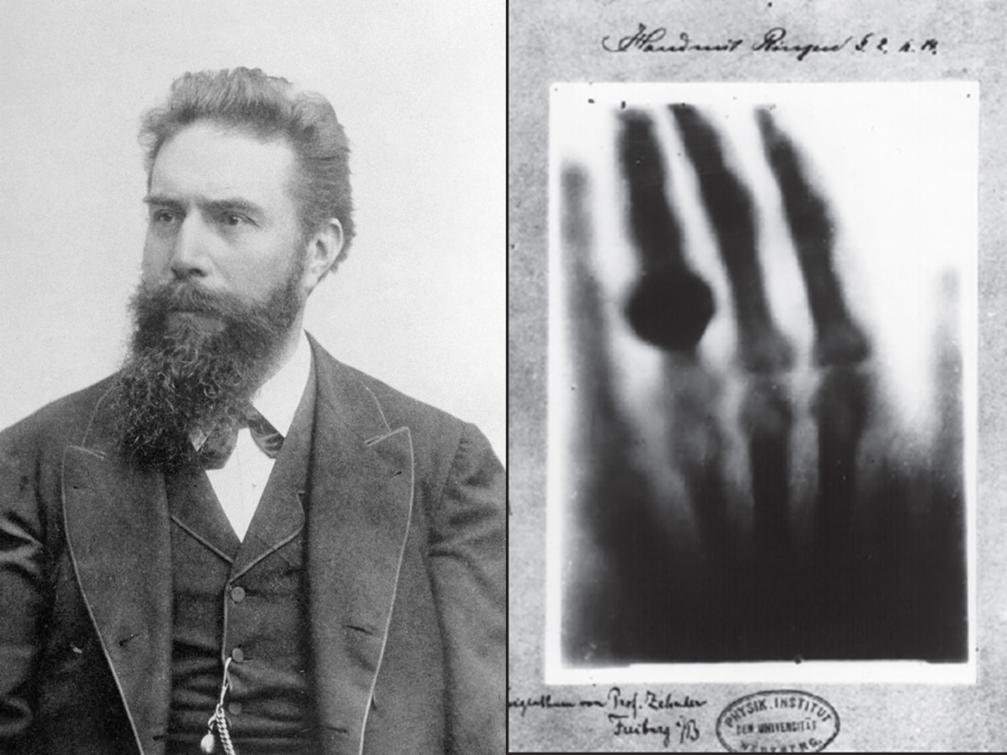
A severe, thoughtful portrait of Wilhelm Conrad Röntgen sits beside one of the most astonishing early scientific records: an X-ray image of a human hand. The contrast tells the story at a glance—Victorian respectability on one side, and on the other a ghostly glimpse beneath the skin where pale bones and a dark ring stand out. Even without a modern caption, the composition signals a turning point in how people understood the body and the invisible forces that could reveal it.
The hand radiograph, blurred at the edges and darkening toward the fingertips, carries the unmistakable look of a first-generation experiment: exposure times were long, alignment was tricky, and the result still feels like a revelation. That ring, rendered as an opaque circle, became a powerful detail in early accounts because it made the unfamiliar instantly relatable—everyday objects could be “seen” inside an image that seemed to pierce flesh. For anyone searching the history of X-rays, early medical imaging, or the invention that transformed diagnosis, this photo encapsulates the moment the hidden became printable.
Röntgen’s 1895 breakthrough quickly moved from laboratory curiosity to global sensation, reshaping medicine, surgery, and public imagination in a matter of months. This historical photo works beautifully in a WordPress post about inventions because it pairs the inventor’s public face with the evidence of his discovery, turning an abstract scientific concept into something concrete and human. It’s a reminder that the modern X-ray—so routine today—began as a startling experiment that changed how we look at ourselves.