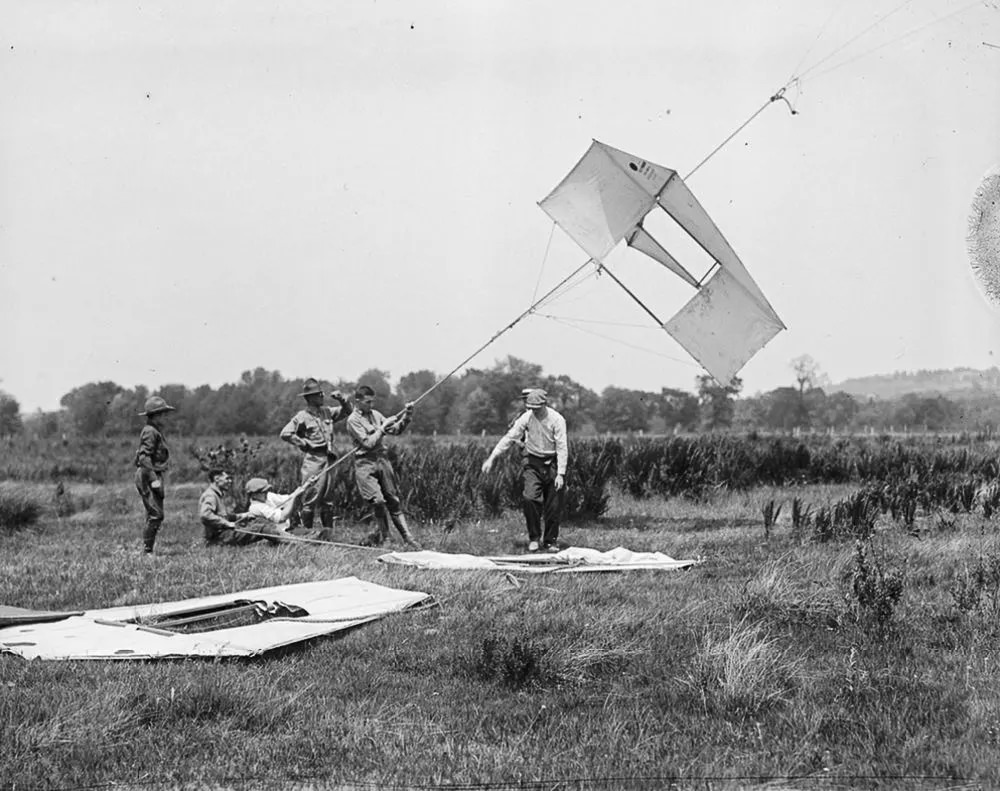
A taut line slices across an open field as a boxy, winged kite pulls hard against the wind, its rigid frame tilting like a small aircraft in training. On the ground, several men brace themselves and manage the ropes with practiced caution, while a folded sheet of fabric and spare components lie ready in the grass. The scene has the unmistakable feel of an experiment: part workshop, part drill, with every stance suggesting that the next gust could change everything.
Before dependable airplanes and compact cameras made the sky routine, inventors and military planners looked for other ways to get eyes above the horizon. Man-lifting kites promised a simple kind of aerial reconnaissance technology—one that could be transported, assembled, and flown from relatively ordinary terrain, relying more on wind and teamwork than engines. Images like this hint at the practical realities behind the idea: careful rigging, testing lift and stability, and coordinating ground crews to control ascent and recovery.
The incredible history of man-lifting kites sits at the crossroads of invention and necessity, where bold concepts were judged by whether they could withstand weather, weight, and human nerves. Even without a visible observer in the air, the photograph evokes the core purpose of these early aerial platforms: gaining altitude for scouting, signaling, and observation when other options were limited. For anyone interested in forgotten inventions, early aviation experiments, or the evolution of reconnaissance, this moment in the field offers a vivid doorway into a technology you probably never knew existed.