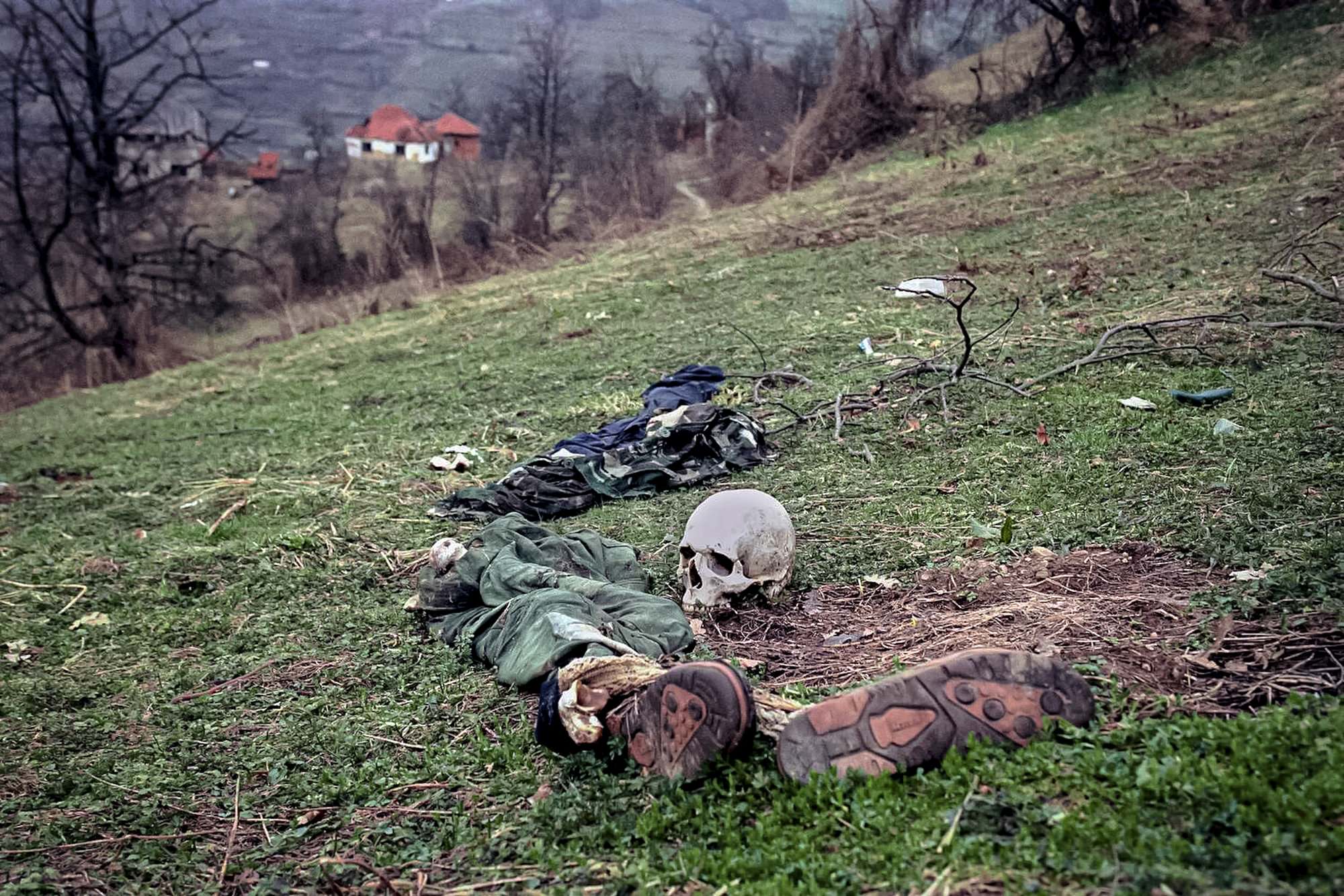
Across a sloping field in Konjević Polje, the ground is scattered with the harsh evidence of loss: a skull, shoes turned upward, and fragments of clothing lying where they were left. In the distance, bare trees and a few houses sit quietly against the hills, an everyday rural backdrop that makes the foreground’s violence feel even more jarring. The title situates the scene on April 2, 1996, northwest of Srebrenica, at a suspected mass grave site—an image rooted in the aftermath of civil war rather than the battles themselves.
Nothing here is staged for drama; the composition relies on stark proximity, bringing the viewer close to items that once belonged to living people. Mud, grass, and tangled branches frame the remains, while the scattered garments suggest hurried, chaotic events that unfolded beyond the camera’s reach. As forensic searches and exhumations unfolded in this period, such fields became places where families, investigators, and communities confronted what had been hidden.
For readers exploring the history of Srebrenica and the wider Bosnian conflict, the photograph offers a sober reminder of how violence persists long after gunfire ends—embedded in landscapes that must carry memory as well as daily life. The suspected mass grave at Konjević Polje stands as part of a broader story of war crimes investigations, identification efforts, and the struggle for truth. It is an uncomfortable, essential record of the human cost of civil wars, and of the painstaking work required to recover dignity from devastation.