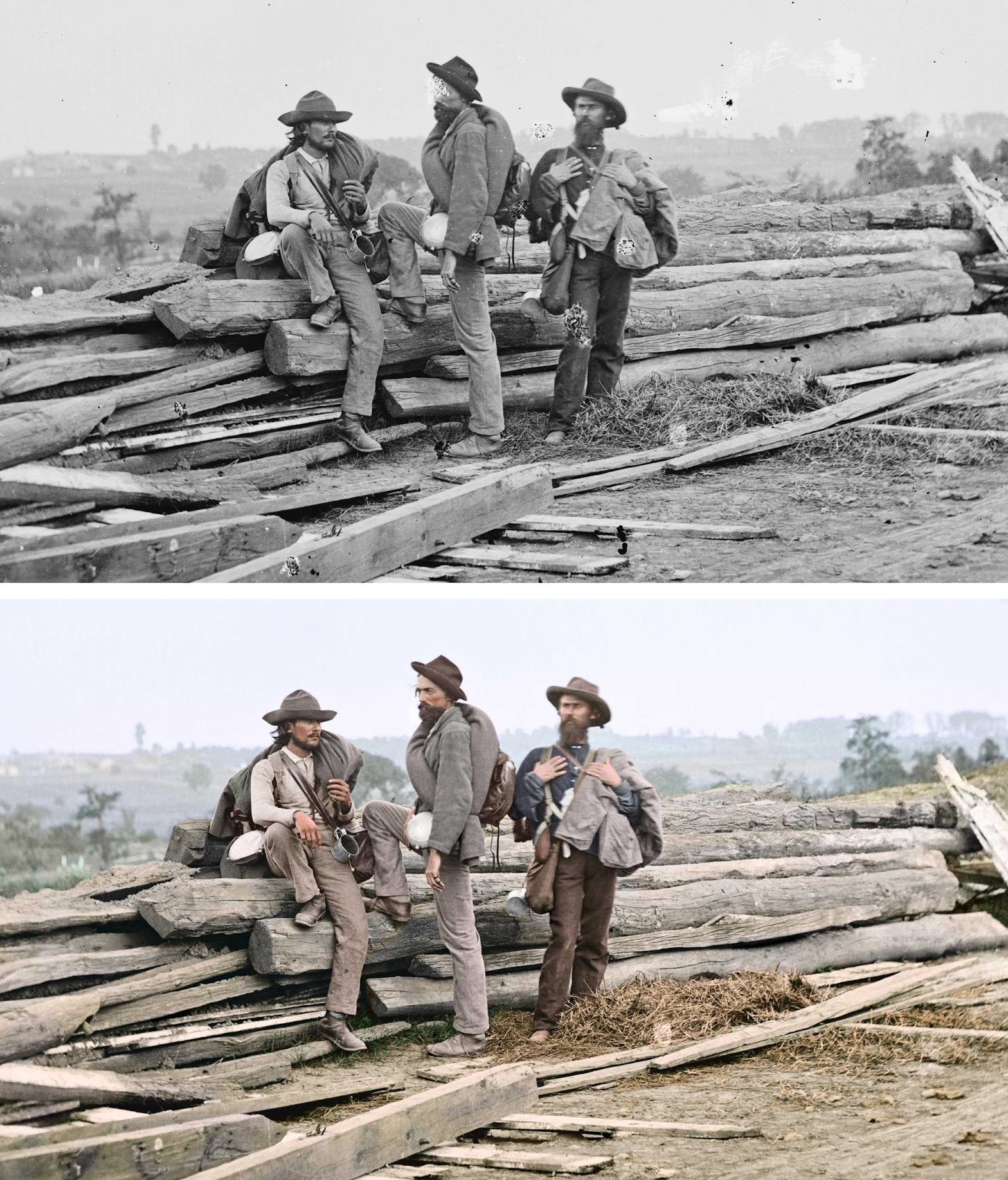
Along a rough split‑rail fence on the Gettysburg landscape, three Confederate prisoners pause as if caught between exhaustion and wary attention. Their civilian-style hats, rumpled jackets, and slung blankets read like a soldier’s life reduced to what can be carried, while tin canteens and small personal gear hang at their sides. One sits on the rails, another leans with a bent knee, and the third stands slightly apart, all three facing the camera with expressions that suggest fatigue more than defiance.
Details in the clothing and equipment pull you close to the everyday reality of the Civil War: coarse fabric, mismatched layers, and the practical improvisations of men on campaign. The fence itself—sturdy, irregular, and broken in places—anchors the scene in rural Pennsylvania and hints at how quickly farmland became a battlefield and a holding ground for captives. Behind them, the soft, hazy hills feel quiet, a sharp contrast to the violence associated with Gettysburg in June–July 1863.
For readers searching Civil War history, Gettysburg prisoners, or Confederate captives, this image offers a rare, human-scale view of the conflict’s aftermath. Instead of generals and grand movements, the focus rests on three ordinary men in a moment of limbo, their posture and possessions telling a story of surrender, survival, and uncertainty. It’s a reminder that the battle’s legacy was not only written in strategy and casualty lists, but also in faces like these, standing beside a fence with nowhere certain to go next.