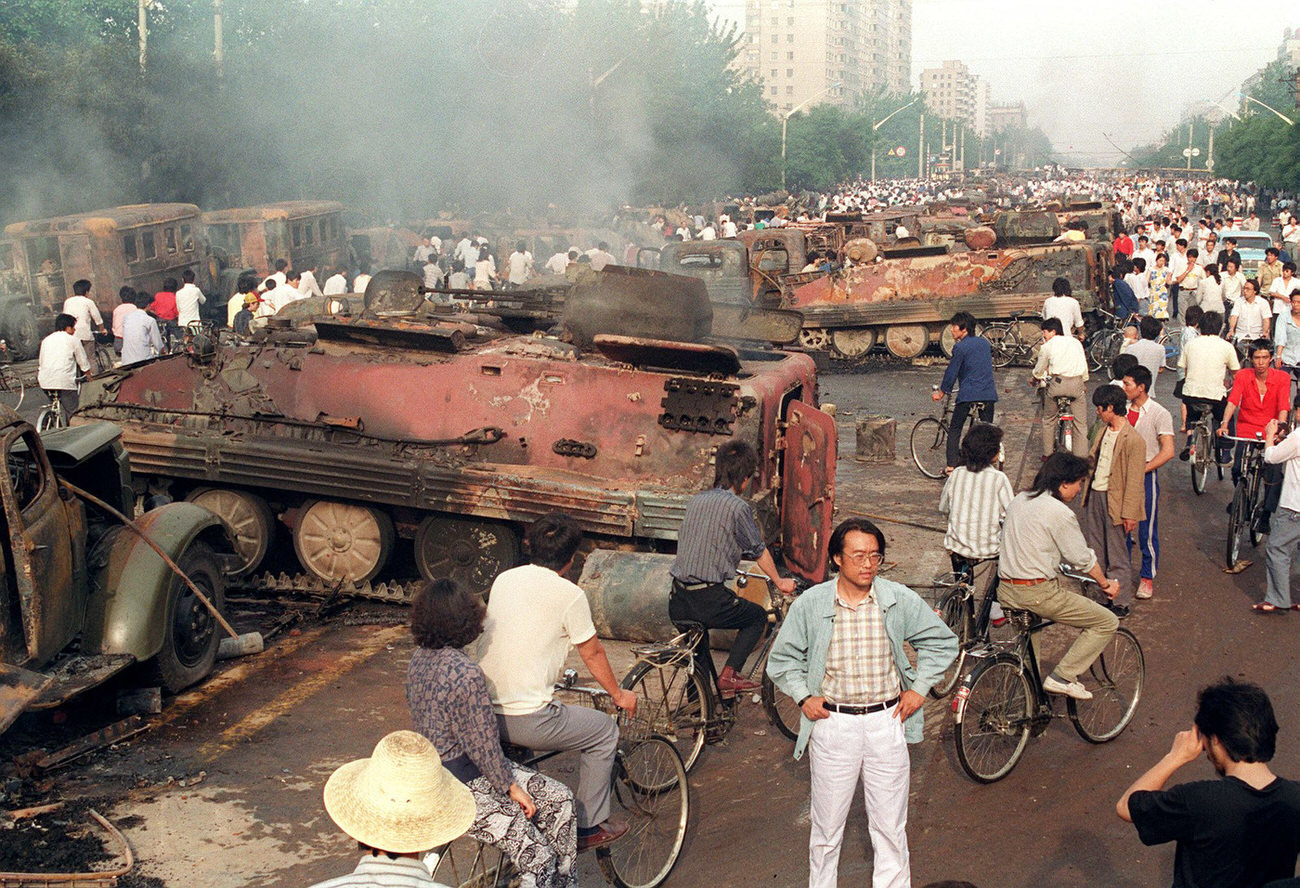
Smoke still hangs over a broad Beijing avenue as residents on bicycles and on foot weave around the hulking shells of armored personnel carriers. Their scorched paint, warped panels, and exposed tracks turn military hardware into wreckage, while crowds press close to peer into open hatches and interiors. In the distance, the roadway narrows into a dense river of onlookers, framed by trees and high-rise buildings that make the scene feel both everyday and suddenly unreal.
The title points to the tense purpose behind this destruction: demonstrators burning more than 20 vehicles to prevent troops from moving toward Tiananmen Square. That detail shifts the image from spectacle to strategy, a moment when ordinary city streets became a contested corridor and civilian bodies formed an improvised barrier. Faces are turned toward the damaged carriers with a mix of curiosity, defiance, and disbelief, as if trying to understand how quickly authority can be challenged—and how quickly it can return.
For readers searching the history of Beijing protests, Tiananmen Square, and civil conflict in modern China, this photograph offers a stark study in urban resistance and its aftermath. The contrast between bicycles and armored vehicles underscores the imbalance of power, even in victory-like ruins, and the crowds suggest a collective witness determined not to look away. It’s a reminder that history is often recorded not only in speeches and decrees, but in the charred metal left behind and the people who walk up to it, intent on seeing what happened for themselves.