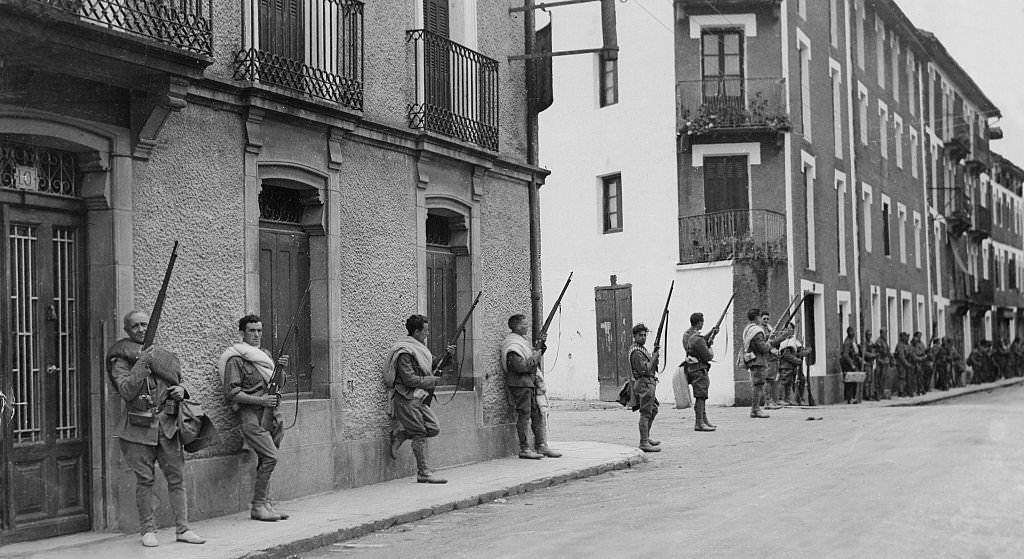
Along a quiet-looking street of plastered façades and iron balconies, Nationalist soldiers take up positions with rifles angled upward, scanning the rooflines for movement. Their spacing is deliberate—some pressed to doorways, others posted at intervals near corners—turning everyday architecture into cover. The empty roadway and shuttered entrances hint at a town freshly seized, where the fight can continue even after the front line has rolled on.
Urban combat in the Spanish Civil War often unfolded vertically as much as it did along streets, with attackers exploiting upper floors, terraces, and rooftops. Here the men’s attention is drawn above the street level, suggesting shots or threats from hidden vantage points, and the defensive posture conveys the nervous pause between bursts of violence. Balconies, window frames, and hard walls become tactical features, a reminder that in 1936 the war quickly colonized civilian spaces and reshaped them into battlegrounds.
For readers tracing Spanish Civil War history through photography, the power of this scene lies in its stark normality: residential buildings, a straight road, and soldiers waiting for an unseen adversary. The image speaks to the uncertainty that followed a capture, when control had to be asserted block by block and any rooftop could still resist. It’s a concise, unsettling glimpse of how occupation, defense, and fear could settle into the daily geography of a town.