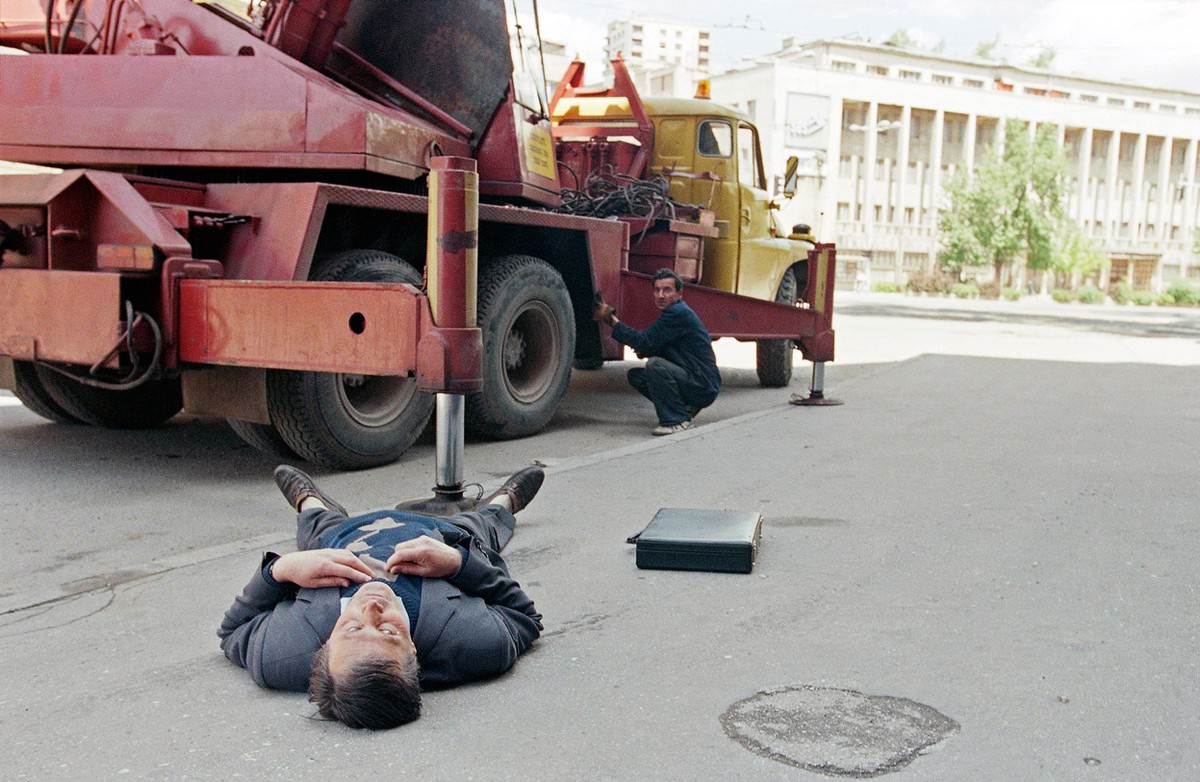
A quiet city street turns into a killing ground in this stark Sarajevo war photograph, where the body of Rahmo Seremet, a 54-year-old city engineer, lies sprawled on the asphalt. His suit jacket and loosened tie suggest an ordinary workday interrupted without warning, while a closed briefcase sits nearby like a final, mute witness to routine interrupted by violence. The wide roadway and institutional buildings in the background underline how public spaces during civil wars can become places of sudden, indiscriminate danger.
Behind a large truck, a man crouches low, using the vehicle’s heavy frame as improvised cover while keeping his eyes on the fallen victim. The posture conveys a city forced into constant calculation—when to move, when to freeze, where a sniper might be watching. The truck itself, a piece of urban machinery meant for construction or municipal work, becomes a shield, turning the tools of everyday life into survival gear.
Stories of the Siege of Sarajevo are often told through grand strategies and political milestones, yet images like this return the focus to civilians and municipal workers caught in the crosshairs. The title’s detail—shot dead by a sniper—anchors the scene in the lived reality of street-level terror, where crossing open ground could be fatal. For readers searching for historical context on Sarajevo, snipers, and the human cost of civil conflict, this photo stands as a painful document of how war collapses the boundary between public service and mortal risk.