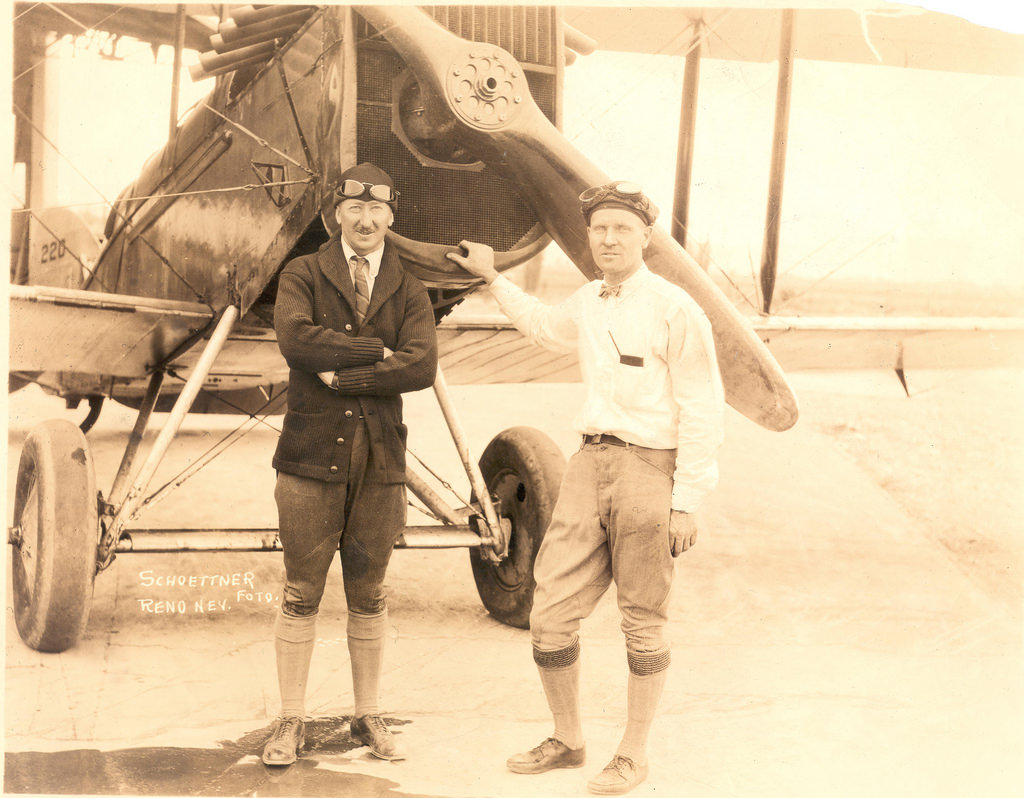
Leaning against the nose of a rugged biplane, airmail pilots Edison Mouton and Rexford Levisee pose with the easy confidence of men accustomed to wind, vibration, and tight schedules. Leather caps and flight goggles sit ready, while knit sleeves, laced boots, and breeches hint at the practical wardrobe early aviators relied on to stay warm in open cockpits. The aircraft’s exposed struts, wires, and broad propeller fill the frame, turning the portrait into a close-up study of how early flight looked and felt at ground level.
In 1921, carrying mail by air was still a bold, evolving experiment—part transportation service, part proving ground for new machines and techniques. Every visible detail, from the heavy landing gear to the engine cowling and prop hub, speaks to a period when aviation technology was advancing fast but demanded constant skill and nerve. Seen today, the photograph doubles as an “inventions” story: not only of the airplane itself, but of the systems and routines that made reliable airmail possible.
Along the lower edge, the photographer’s imprint reads “Schoettner Reno Nev. Foto,” grounding the scene in Reno, Nevada and adding a local documentary touch to this early aviation moment. The composition is simple—two pilots, one plane, a wide expanse of airfield—yet it captures the human scale of innovation, where progress depended as much on steady hands and judgment as on wood, fabric, and metal. For readers searching vintage aviation photography, early airmail history, or 1920s pilots, this image offers a crisp window into the everyday heroism of flight’s working era.